


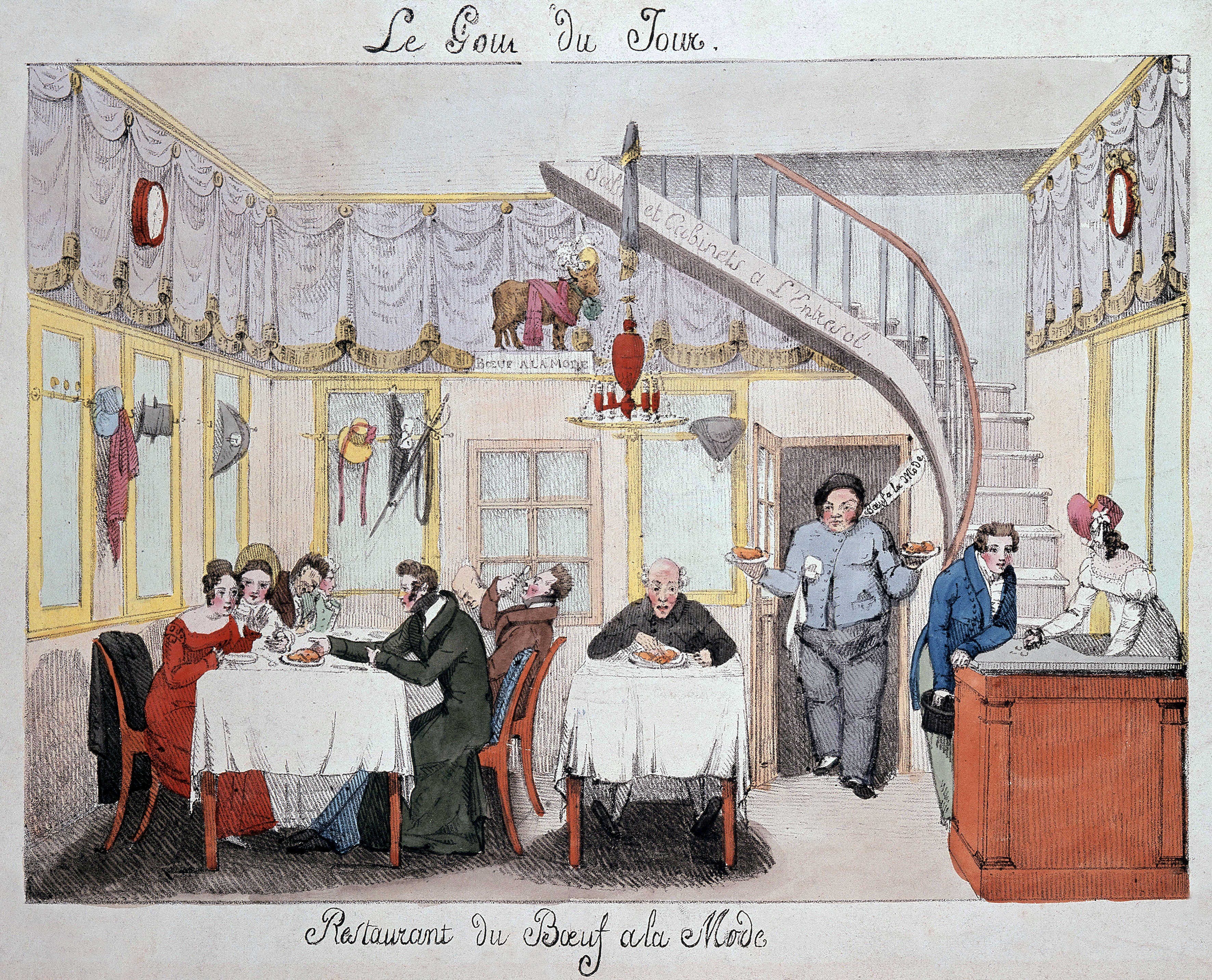
**Gratuity is Included for Parties of Six or More**
“Cooking is a Philosophy; it is not a Recipe.”
-Marco Pierre White
I. Amuse-Bouche.
Many words have been printed on the romantic couplings of the writer to the specific “home” bar or tavern of their choice. Hemingway had the Ritz, Hunter had the Woody Creek Tavern, Maupassant had the Moulin Rouge, and so on. Some have had signature cocktails, others have consumed what is most readily available with the strongest proof. I myself have neither, and I feel a certain reservation in the case of the writer seeking their watering hole for the purpose of making it theirs. I have been to the Woody Creek Tavern and seen the table they say that Hunter drank in, and I have been to the Woody Creek Tavern before it was a starred dining experience to see the real Hunter on the porch swing outside. It has never appealed to me to write in a bar. With this said, there is a need for every writer to have a haunt. Somewhere they can go to see and be seen, and where they may be known if only in the moments they allow themselves to be. Further, there is a need in the process to step out into the world on the hunt for food as a means of distracting one’s mind from the writing tasks of the day. I still can’t imagine it being a bar for me.
Aside from the noise, the intrusions, the nonsense, there is also a seemingly ever-present coagulate of people who have seemingly forgotten that their bodies exist in space with others. I have the curious habit too, among writers mentioned that my drink of choice seems to not be in line with the hard living of my deceased compatriots. I have maintained for quite the majority of my writing career the stable companionship of a standard Pepsi cola, or in the more halcyon days pre-2020, a loving and perpetual relationship with TaB cola until its untimely demise in the pandemic. Black coffee has often punctuated the draining of the cans and serves as both a caffeinated boost and an introduction of refined charcoal into my kidneys to ensure their longevity follows the rest of the body more closely. There is water in either, my case rests.
I do not drink to a terrific extent, I missed the light beer and bonfire era of high school as I was too busy reading, playing video games and daydreaming to no end. The first time my father ‘caught’ me with alcohol was when I was 24 years old and the offending brew had been a $170 bottle of Jameson Gold Reserve. I have not been above bathtub indulgences in iced gin, nor have I strayed from my respect for a perfectly chilled bottle of Russian Standard Gold. I do not drink to excess, but can, in limited modalities, enjoy the complexities of the poisons. As such, I do not have a ‘signature cocktail’. At the grad student bar in Victoria it was a double shot of straight Victoria gin, not Empress, not Bombay and that more or less concludes the extent to which I have cared about such indulgences, preferring instead my standard drink order from Shari’s Restaurant off of 9th Street in Corvallis Oregon, often enjoyed between the hours of 3 and 6 am: ice water, black coffee, and a coke please.
That said, there existed one place in my hometown that had an alcoholic potion that was nothing short of perfection, one that, had I possessed the more substance-infused side of the Gonzo method, and had I lived closer to town where a long drive in the dark would have been dangerous, would certainly have become what I may consider to be a signature.
In a restaurant space on Main Street across from the town’s saloon that has stood since the 1880s, where my great-grandfather drank, and where my grandfather ordered Coca Colas from the fountain, stands a yellow brick building that, for my childhood, had been known to us as “The Ship of Fools.” It is no longer known in this way. I only visited “the ship” once, when I was 9 or 10 years old. My parents, my brother and I went for a comedy show night and I remember distinctly that the vaguely cowboy-themed comic at one moment asked the crowd “are there any cheatin’ men here?” Which, to my mind at the time, referred to using cheat codes in video games. Having just prior to that rented Goldeneye 007 for the Nintendo 64, and having just applied cheat codes, and (at the time) identifying as male, my hand shot up into the air. No one really noticed but my parents who explained my misunderstanding to me, but in that moment, upon the Ship of Fools, I was for a brief time a Cheatin’ Man for my digital indiscretions.
That yellow brick building has changed names many times, but today it exists as The Brass Anvil. I neither like nor dislike The Anvil, I have had good meals there, with good company. I have also at times used it as a crowded and loud backdrop to newspaper interviews, particularly those that involve the seedy underside of local political scandal. I would not claim to be a regular, but I am not a stranger to its modern chic walls. The Brass Anvil once was home to the greatest cocktail ever mixed by human hands. I was as known as an irregular could be known there as “the only one who ever orders this.” It was officially called the Tuesday Afternoon. I unconsciously but intentionally renamed it in my memories to the Tuesday Morning, as I prefer The Pogues to The Moody Blues, but this is neither here nor there.
The Tuesday Morning was served in Victorian antique crystal coupe glasses, was perfectly chilled and refreshing for any time that saw me at the window seat looking out over the comings and goings of Main Street. It was unique for the region as it was an absinthe-based drink that was not the over-complicated Sazerac of the Up-Valley Aspen crowds, but something wholly unique. Like the real-life Tuesday mornings, this potion was not something that is veiled in any coat of honesty. It was a place between truths and fictions that lead us into the long ahead weeks of crushing reality on the sunny side of Wednesday. It was made with Emperor Norton Absinthe Dieu, which tastes less like a good French or superb Swiss absinthe and instead lands you somewhere into the realm of what the Dennis Quaid vintner father from the Parent Trap would consider the green fairy. It is made with overly sweet California white grapes distilled into a sickening brandy and then stewed with the traditional herbaceous botanicals, but in a balancing act that feels more akin to stacking ping-pong balls than building a house of cards. Much like the way that a given Tuesday morning may hide all its horrors behind a veneer of sunshine and rainbows, this base lulls one into a false sense of cultured security. I may have been the only one ordering it because it was itself bad absinthe.
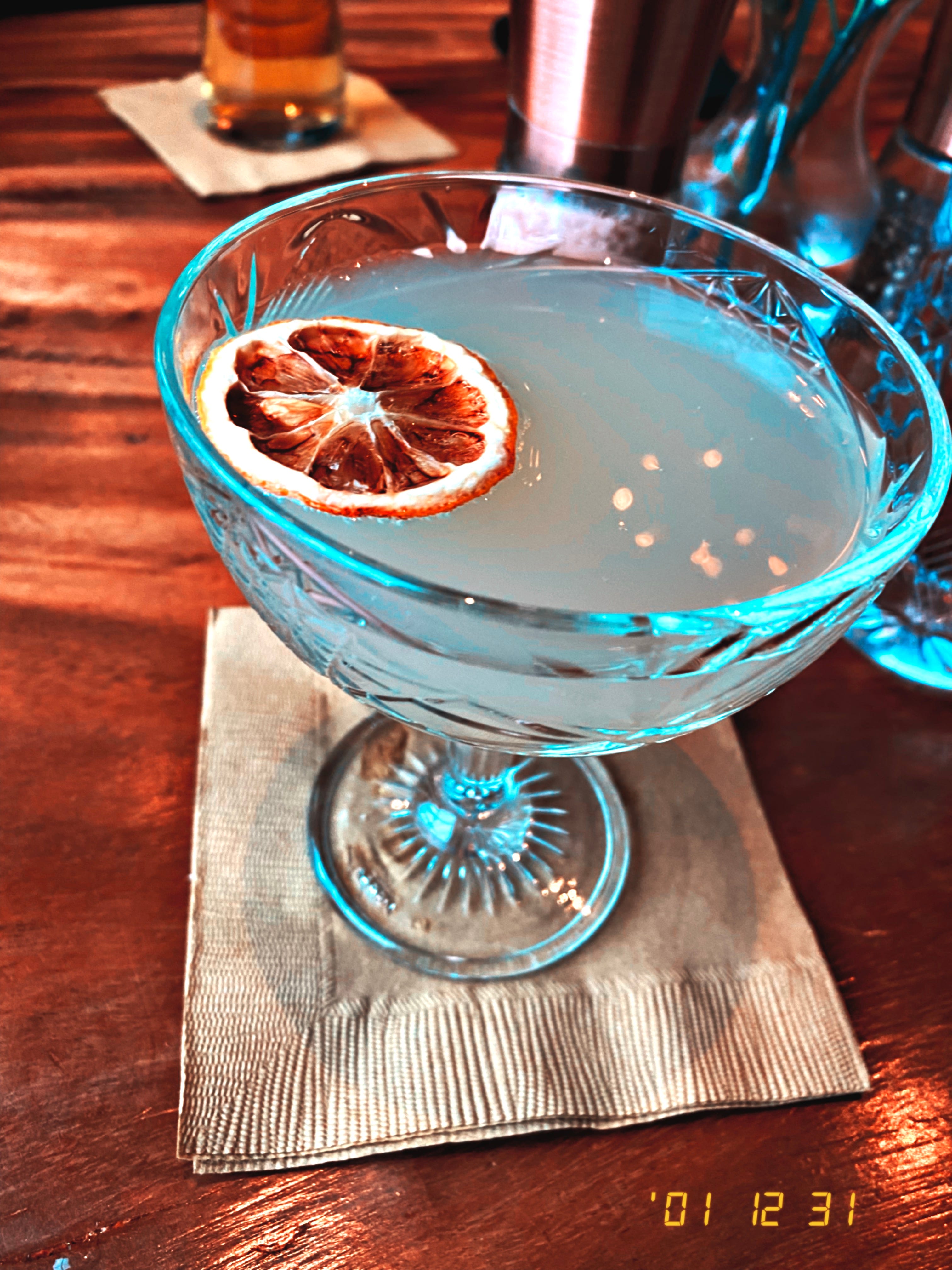
To Emperor Norton’s jade liqueur was added a dash of simple syrup, club soda, and a floating dried slice of blood orange or tangerine that never once added any flavour notes to the mess. The simple syrup was almost too much every time, and the shot of club soda at times barely allowed for the louge of the spirit to run. In other words, my green fairies often felt unmotivated to wake up for their Tuesday morning, let alone stay awake for the afternoons. This cocktail was something I consumed three times and then it disappeared forever. The challenge with being a hip young-people’s chic modern gastronomy emporium is that consistency is overrated. The notion of maintaining some semblance of traditional cornerstones of one’s menu is just too gauche in the eyes of seasonality, rotating bartenders, and absurd notions (like smoking rosemary simple syrup, or using the water from a tank in the meat smoker to make ice cubes) to even dream of keeping the one good and obscure drink on the menu. Instead, much like every Tuesday Morning I have experienced to date, the cocktail of the same enforced name has faded into memory, but it stands as a small introductory sampling into the unique melodramas that food and drink carry with us into our navigations of the daily world. I had that cocktail on three memorable days, once while interviewing a source, once by myself in the rain, and once with my two brothers on a snowy New Year’s Eve. Each time, important, memorable, and just eccentric enough with the associated greens of a fae creature in the glass.
The Tuesday Morning
Something Adjacent to Hemingway’s Death in the Afternoon, a Real Writer’s Cocktail…
In a Champagne Coupe Combine:
Crushed Ice
1.5 Oz. Good Absinthe Vert
.25 Oz. Simple Syrup or a Single Sugar Cube
Top with Good Club Soda, Ideally One on the Lower End of the Sodium Spectrum
Stir to Combine
Serve chilled with a Slice of Caramelized Blood Orange
Consume and compose.
II. Hors d’Oeuvres.
In a similar fashion to the magical decays of the earth and the natural world to the kingdom of fungi, the rot and putrefaction of the small, formerly working-class towns is the unstoppable march of gentrification. Gentrification is one of those rare words from the lexicon of sociology to break out into the real world, and one that is used almost correctly. In its sociological form, gentrification refers to the process by which neighbourhoods of the formerly working-class are invaded by the middle and upper-middle classes seeking a chic change of scenery. The problem for these invaders is that the nature of the working-class neighbourhood is usually too rough, multicultural and diverse for their palates. So, these gentrifiers, while extolling the faults of the busy suburbs they left behind, endeavour to transform their new neighbourhood into the precise monochromatic, monocultural blurs that they have moved away from. “New York has this, and this town doesn’t, so I need to add one” and other associated nonsense. Starbucks has traditionally been a good measure of North American gentrification, where once one pops up in a traditionally low-income or ethnically diverse neighbourhood, it is sort of a given fact that a wealthy white tide is inbound to commodify urbanity into a neatly presentable Instagram story.
The way the non-sociological public often uses the word is to describe a particular genre of restaurant that caters to a mad hatter’s idea of what a millennial trust fund kid (or “Trustafarian”) would imagine to be a very swanky place. These are the burger joints that serve their food on metal trays or in cast iron skillets (the aforementioned Brass Anvil does this), and does so with an unnamable air of entitlement about their food. Somehow, a simple frozen beef patty on soggy bulk-baked brioche with “house sauce” (mayonnaise and Hunt’s tomato ketchup) with one tinge of butter lettuce qualifies as a Michelin-adjacent $28.00 dining experience. It is too cliché to say that these places play Mumford and Sons because I think that somewhere Mumford and his sons may have some good tunes here and there. Instead, there’s a weird blend of Britpop (but usually only Wonderwall and the other mainstays), mid-2010s house music, and the occasional Dead South song. There is typically a palpable lack of soul in these places, where you could enter one in Boston, walk outside into Downtown Denver and never realize you were actually at the breakfast joint in the London Gatwick terminal.
The dividing line in spaces of creativity that sets artistic creation aside from commodification of time is the depth to which such a place may retain and reflect a soul. The gentrifier’s kitchen is soulless. It lacks creativity, gastronomical know-how, and the homeliness of a careful hand at the stove. In my life, I have excused many an amateur cook’s home-cooked meals that were less than delicious as being not failures, but themselves gestures to appreciate. As a kid, I ate many a burnt grocery store hamburger that someone’s dad made for their birthday barbecue with a smile and a note of thanks, because the soul of the outdoor kitchen is not in the gourmet creations, but in the memories shared. In the gentrifier’s restaurant, on industrial steel stools, with fries served in half cylinders of aluminum, I have felt nothing. No compulsion to remember the moment, and no memories worth remembering from the surrounding clientele. Somehow, the idea of eating in a hybrid tattoo parlour or autobody shop just does not lend itself to a memorable positive experience. As such, I could have one of these burgers in The Dalles Oregon, Salida Colorado, O’Hare Airport, or (hopefully never) in Denver and I could never once recount which was which, and this is the inherent problem in the gentrification of the neighbourhood, the “mayonnaise is spicy” crowd can’t handle a walk on the offside, let alone the wild side, and so what we are left with is something two degrees below tepid.
A telltale sign of such places is their refusal to use the word ‘appetizer’ to describe the small dish ordered before the main. A three-Michelin-starred restaurant once called them “starters,” and now here we are. “Starters” is a good sign that the rest of the menu before you will be overpriced, underseasoned, and unremarkable as long as the prices still have dollar signs in them. Chilli’s, a mainstay of off-the-interstate Americana, is nothing to write home about (unless you’re requisitioning antacids), but at least they have the good sense to use ‘appetizers’ as a moniker for their triple dippers.
What blends most exquisitely with ‘starters’ in the gentrifier’s kitchen is not the local microbrewed IPA that tastes like spring cow runoff, or the house porter that I am certain is brewed with gym socks. No. What blends best with such things in these soulless places is an unearned, unrequited, and impolite dose of ego, seasoned perfectly with a strange entitlement and superiority complex, and served chilled along an outstretched palm demanding platitudes on top of the tip.
Several months ago, I found myself in one of these places called simply The Beer Works. This locale has held a place of scorn in my mind for many years, as it replaced a shop I had often frequented with my mother called The Artist’s Collective. This was a place to purchase toys, games, books and other pieces of creative souls that were all some degree of handmade by very talented artisans. In direct contradiction to the spirit of that place, the Beer Works offers less in the way of original artistic creativity than the worst Applebee’s adjacent to the airport of any given small American city. As with such places, it is often crowded with the types that seek such originality without the capacity to engineer it themselves. I do not dislike nor disdain these people, but they are not the sort that I can mix with for very long.
As it would happen on this fateful day, I had a meeting scheduled in the same locale for later that evening. Some ultimately sordid business about the acquisition of a theatre that ended with its own sour notes. Prior to that, while toiling in my office on a larger literary project, the notion struck me that it had been over 18 hours since my last meal, and the morning’s coffee had all but rendered me in that curious academic middle ground between being barely awake and deathly tired. Typically, I would have walked out into town to the stalwart pizza shop that has been a staple since my childhood, but for whatever reason, that day, I opted to saunter into the soulless realm for a small bite. Existing also in the perpetual state of near-death poverty of the working academic, my budget was not one to walk past the ‘Starters’. Ironically, this establishment does not call their appetizers ‘starters’ and instead opts for the more playful ‘snacks’ menu instead. The spirit of the starter remains, however, lurking in the shadows to stage left.
Not wanting to stay there for an extended period of time, I opted for two to-go orders of their pretzels and beer cheese, which I augmented with mustard from the office fridge upon my return. I thought next to nothing during this encounter. I sat at the high table on the industrial stool while my legs fell asleep and thumbed through the various second-hand books that I had previously acquired at the thrift store down the street. My food came, I paid, and walked back to the office. I ate my pretzels (which were fine) while watching a YouTube video essay, and all was easy and well. The hour of my meeting came, and diligently I returned to the venue to engage in the types of meetings that happen in small town political circles, ones in half-shushed tones that are a mixture of nostalgic reminiscing, subtle flexing of our generational ties to the town, and a sense of conspiracy that far outpaces the gravity of the situation on any more macro stage. Having already eaten and not wanting to try any of the local brews, I opted for a Coke and paid more attention to my pen and notebook than the beverage.
The curious side dish of ego came when I ordered my drink, where a man who I had not spoken to in my earlier visit loudly asked me if I was back solely to buy more pretzels and beer cheese. When I said I was not, he said back to me in what I assume he thought sounded like exasperated mock anger:
“You could’ve just said yes to appease my ego.”
I cannot remember my remark that I said in response to this statement, but I would imagine it was some kind of flat agreement with the sentiment.
“Yes, I could have, but no, I had a meeting here.”
Something to that effect.
I do not typically go to restaurants to appease the egos of their wait staff, nor am I the flavour of millennial that likes the brash, playful confrontational style of these soulless places. I do not possess the baby-boomer and GenX mentalities that I am to be the supreme being of my dining experience, I do not see service workers as beneath me, nor do I remotely believe that the customer is ever (if at all) always right. I have dined with such people, the types who intentionally order something monstrous from the menu, dislike it, send it back and then demand a comped replacement and use this façade as a means of gauging whether to leave a 10% tip or none at all. Once at our local breakfast place, I witnessed one of my dining companions, who I knew disliked both cornbread and spicy foods, order cornmeal jalapeño pancakes, douse them in maple syrup, try one bite and declare that she hated it, made a show of having it sent back for standard pancakes, eggs, bacon, and toast. The kicker to that nonsense was twofold. First, she said she “always” got these pancakes, and second, she was upset that they had not been comped on her bill (that someone else was paying).
The baby-boomer/GenX diner is a wild breed. Someone who seems to have zero concept of the world other than the idea that it exists to serve them. As a sociologist, I searched for a long time for the reason for this. I planned studies and (this was back when I still cared about such things) journal articles on the subject. I stumbled upon the solution one late evening during the pandemic that answered the question in such a complete and total way that I abandoned that direction of research entirely. It is very annoyingly simple. The answer came in the form of a training video for a regional grocery store chain in the early 1980s. Within this video, it trains the GenX employees to bend over to impossible angles for the angry, entitled boomer guests. One training scenario depicted the young employee having to swallow their frustration at a customer demanding that the store honour a coupon from another, competing store. The solution per the video? The manager just gave the customer the same discount with a warm, almost coddling apology. Instant gratification. Total servitude. I think this is the genesis of the issue; there’s a curious blending of entitlement and an expected deference to the customer over reality itself. So, we have a generation that grew up being broken down to serve a generation that expects the world to operate as their personal concierge. Madness.
Because I try to avoid this kind of mindset entirely, I find that even when met with the poorly seasoned and undercooked ego of the random server in this soulless place, instead of demanding a manager “make it right,” I just never go back. I haven’t yet, don’t plan to, and I’ll never schedule another meeting there again. Life is too short to deal in ego, and far too short for mediocre pretzels.
As far as ‘starters’, there are a few redeemable ones I think, but the following has been a longtime staple.
Roasted Brussels Sprouts
Serves six.
Preheat Your Oven to 230C/450F
You Will Require…
1kg/2.2lbs Fresh Brussels Sprouts; Halved, Rinsed, and Dried
1 Large Sweet Onion, Diced
2 Cloves Garlic, Smashed
Sufficient Good Olive Oil to Coat
5g/1tsp Dried Herbs de Provence, Lightly Crushed to Open the Fennel
Salt and Pepper to Taste
For the Glaze..
118ml/ ½ cup Red Wine Vinegar
118ml/ ½ cup Balsamic Vinegar
12.5g/ 1tbsp. Raw or Granulated Sugar
Good roasted vegetables ought to be the pride and joy of any cook’s kitchen. They are simple, primal, impossibly difficult to make ‘work’ and the ultimate satisfactory dish for one’s entrée or as a side.
Chop your onion in medium dices, between a fine mince and a large stew cut. Toss half of the onions in olive oil, salt and pepper and layer them into a rimmed baking dish, you do not want to do this on a baking sheet as we are wanting to retain as much moisture left in the pan as possible. Crush the garlic cloves and add them with the onions. They should not be too finely minced so as to dissolve into the roast, but not too large that they resemble baby teeth in shape and size.
In a large bowl placed the rinsed and dried halves of the sprouts and coat them generously in olive oil. Lay them out on top of the onions with the inner cut side facing up and ensure each is well coated, if they are not, the individual layers will burn and not caramelize. Lightly crush the Herbes de Provence between your fingers as you season the sprouts from above. You do not want powdered herbs as they may become too concentrated in the folds of your sprouts, instead the goal is to have them float somewhere between the surface and the innards. Be sure as well to not overdo the herbs, there are strong flavors in here like anise and fennel that can overpower. Sprinkle a gentle flow of salt and pepper over the herbed sprouts (you will test for seasoning later, so do not overdo it here, the salt is there to draw out a bit of moisture and the pepper is included because if I wrote to add pepper later, most would forget it entirely).
Bake the sprouts in a hot oven for 30 or so minutes until they take on a deep caramel colour on the fringes of the leaves on top, and are tender to a fork. There is not a specific time, all ovens are different, be a cook and check. When they are finished remove them to a serving platter, cover tightly with foil to keep them warm, and retain the contents of the baking vessel.
For the Glaze:
Following the roasting of your sprouts strain the contents of the pan. Discard nothing. Pour the cooking liquid which will contain a good degree of oil (if it doesn’t, add some) into a wide pan over high heat. When the oil is hot and shimmering, add in the reserved ½ of your onion and sauté just until the edges of the dices begin to take on some colour. Reduce the heat to medium and add in the roasted onions and garlic from the pan and both types of vinegar. Most people use a simple balsamic glaze, but I find the fruit notes of the red wine vinegar help add some nice acidity to the dish. Bring the mixture to a low boil and stir in the sugar. Whisk or stir constantly until the glaze is reduced to a thick syrup. Do not walk away from this, it will burn. Taste for seasoning and augment it with salt and pepper as needed. You will know the glaze is ready when it coats a spoon and does not immediately fill in the pan when you draw a spoon through it.
Take a singular sprout from the platter, using a spoon glaze the top, allowing the roasted and sautéed onions and garlic and the sweetened vinegar mixture to dance into the canyons of the sprout. Try it. Does it need salt? Pepper? Adjust for seasoning or tell your guests they may do so as needed. Glaze the remaining sprouts and ensure that each has some onions on top. I finish with a garnish of very course ground black peppercorns from a molcajete.
III. Potage.
The history of space is a unique social fact that comprises our daily movements through being. We often are so tuned into our present moments that the past, however recent, may be somewhere between the forefront of our minds and the recycling bins at the end. Space and history are things that are, I have found, to be far more novel to the American mind than elsewhere. Due to the colonial nature of the North American landscape, the relative age of the still-standing buildings is on the lower end of unimpressive. The indigenous structures that once stretched across the North American continent were almost entirely destroyed under the misguided arrogance of manifest destiny, and what remains in most of the land between the major colonial seaports is a collective of hamlets made of wood that did not survive the marches of the past centuries. As a result, we who have grown up here take with us a very keen sense of wonder over the history of certain structures. Something built in the 1880s is a miraculously historical thing to us. I think this is partially why so many of us experience such an overwhelming sense of awe at every building in Europe that, while maybe just being an annex of a university or someone’s garden shed, predates the founding of our home ‘nation’ by five hundred years. The building’s architecture need not be something stunningly beautiful for us to revel in the age of the pile of stones. This is not a flaw, but a curious thing to watch abroad.
The living history of space also holds a unique charm. What may just be a Victorian bedroom to the visitor is, through the context of the printed sign, elevated to a grandeur when we learn it was once the overnight refuge of President Theodore Roosevelt. Growing up in an area rich with history tangential to this, there are many such spots that, in my own time, I have learned the stories of, and subsequently passed them along to visitors. Here are the hot springs where famous wild west lawman Doc Holliday came to be treated for tuberculosis. This is where Dr. Gonzo mingled with fans. Here’s where the current president was caught cheating on his second wife with his current wife. This was John Denver’s favourite cactus… and so on. An adjacency to celebrity or intrigue imbues a space with an intangible degree of grandeur that somehow compounds what would otherwise be just another space we wander through.
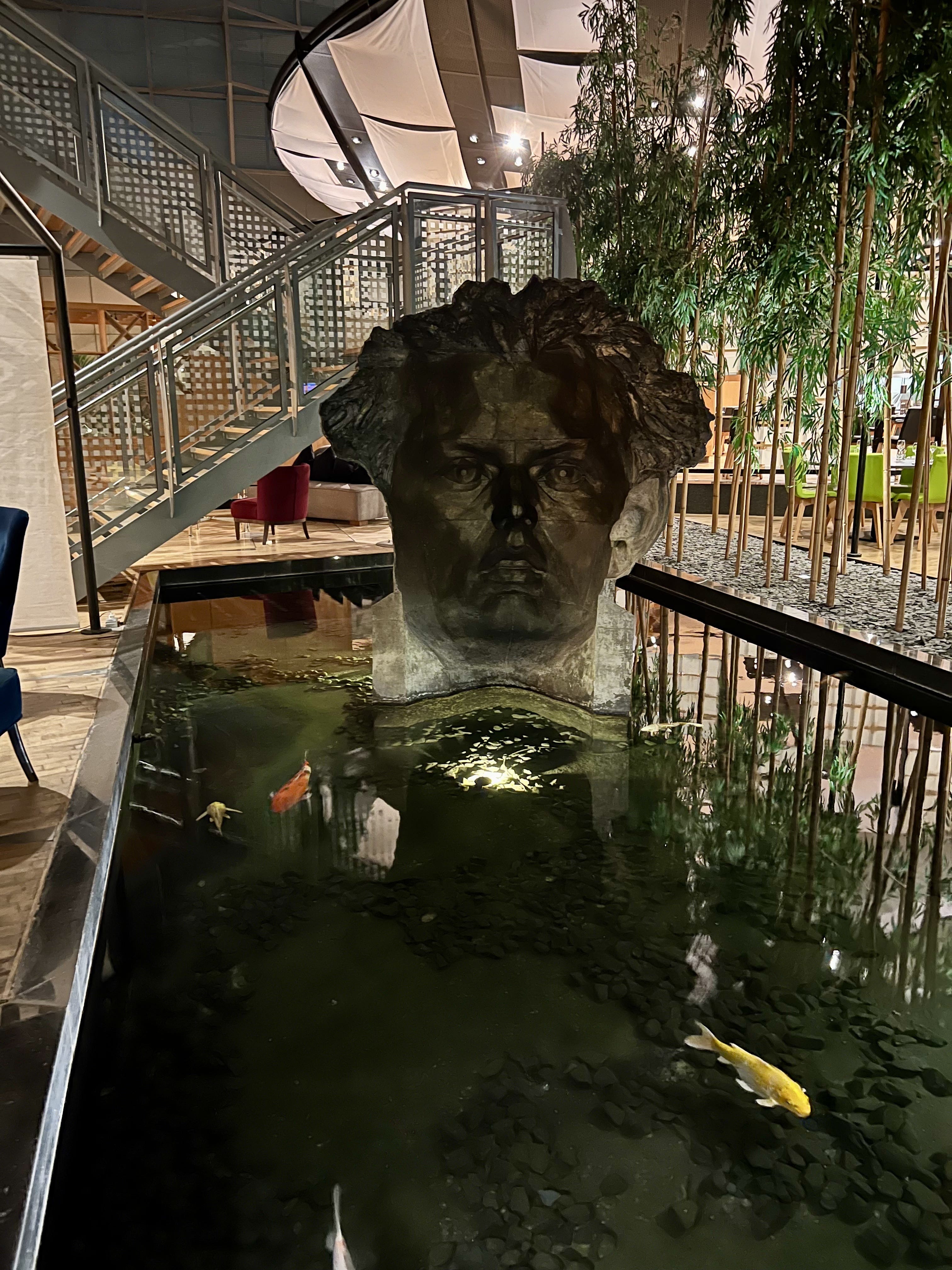
I have walked across many hotel lobbies in my time, and I do hope to cross many more thresholds as things move forward. They are not each without their unique charm. There is an inn I have stayed in multiple times in Mountain Home, Idaho with my dog and that lobby has always been a warm respite from a twelve hour drive, warmed even more so with the night auditor’s impeccable memory of my dog, his name, and how big he got between his first stay as a puppy and his final stay two years later on our last trek home from Canada. He remembered it too as a place that would kindly supply him with his own bag of treats, food and a toy simply for being a guest. The lobby of the Atrium Hotel outside of Charles de Gaulle airport is stunningly well designed, a large enclosed glass structure with a pond in the middle and tastefully incorporated modern art astride the restaurant.
Hotel restaurants are another beast entirely. They are spaces that have more liminality to them than airports after hours. In far-off places, the hotel restaurant may be nothing more than a chafing dish for the morning’s toast and sausages. In grander old cities, hotel restaurants are not solely places weary guests find themselves, but they are places where the knowing public dines as well. The Savoy, the Ritz, etc. My travel budget brackets have never graced me with such breakfasts or dinners, and so I am familiar with the far stranger beast of the mid-tier airport hotel restaurant. There are two subspecies of these beasts. The chain hotels and the independent ones. Typically, though, even the chains have a restaurant that is somehow independently branded from the hotel. You are not eating in the Radisson Dining Saloon #332, but instead at the Lakeview Restaurant and Bar. It has been my experience that in independent places, they simply call these restaurants restaurants.
They are strange because of several factors. Almost exclusively, their clientele are leaving fairly soon. They are travellers. No one books a vacation in their home city at the airport hotel. So you have a large pool of people away from home. Typically, one would assume that they were either leaving home or trying to return there. While it is irregular, I have on occasion stayed in a hotel at the airport in Denver when I was returning home, but that was for the convenience of my ride, and not out of necessity, and it was a surreal experience. The airport hotel fills a necessity for most guests. I need a place to sleep before my 6 am flight, and I do not or cannot drive to the airport that early. In other cases, the airport hotel acts as the catching net for the traveller stranded due to weather or other delays. These sometimes come with a voucher for a meal and a room, but in the US, typically not. As such, the guests of such places are often a dangerous combination of angry, tired, inconvenienced, and hungry. One would assume that such a combination would fill these odd little restaurants with impatient and rude customers demanding their grumbling bellies be filled. In my experience, which itself is limited, but on these occasions, I have found the inverse. After the shock and the rage and the confusion and the obligatory hour in the hotel bed, one can then re-dress for dinner, and they find themselves within a warm facsimile of grandeur. The space, the atmosphere, the faux fancy airs of the décor and the menu exude something of an old-world charm. I am no longer an overheated and tired former passenger of a budget airline; I am now dressed for dinner in the hotel restaurant. It has a certain feel of old-world luxury somehow.
This is not to say that the fare of the airport hotel restaurant is good, but I have yet to experience a meal in one that does not, on the outset, feel good. To sit in the booth in the perpetually low warm lighting, to put in a drink order and peruse the one-page menu is almost something of a bygone era of luxury train travel. In these spaces, you forget that $28.00 for five small cubes of flatiron steak and watery mashed potatoes is highway robbery, and that the audacity to charge a tenner for a basket of fries is tantamount to a declaration of total war. Instead, you let the menu melt into the evening, you situate yourself into the weird rhythm of a place with no regular customers, with no real atmosphere or identity, and instead of recoiling at the utter eccentricity of it all, you smile into your bread pudding at the end and halfway expect someone to offer you a Chesterfield and a nightcap.
The dream carries you all the way back to your room amidst the faux wood panelling, up in the lift, and down the carpeted hallways, right until you fish out the plain grey magnetic card and buzz yourself into your room. You immediately regret setting the air conditioner to subzero temperatures and the cold and the scent of the recycled air shocks you back to realizing that you’re now in for a sleepless night on a mattress made of rocks to wake up at 4 am for burnt coffee that is still on the burner from last night, no breakfast because they start at 6, and then the nauseating shuttle ride back to the airport. The curiosity of the dream state between a cancelled flight and paying your bill at dinner is something that is so innately beautiful to me. It is so human. We arrive in our little huffy attitudes, go be alone for a bit, and then come back down to eat the most mediocre food we’ve ever had, while leaving the angry goblin version of ourselves back in the double queen room. It’s curious, it’s adorable, and it is my favourite element of humanity. That said, if you have ever had the misfortune to travel with a compatriot who does not see it this way, you will know then that solo travel is the way to do it. Being angry and entitled to a fine evening because there’s a lightning storm at your destination is the most frivolous way of living, and these people are far more easily satiated with a delivery order of their chicken fingers and macaroni so that we in the dingy and depressing eatery in the lobby need not deal with the looping pleading with the universe and lamenting over a flight that never took off.
The history of these spaces is not impressive. They are walls that have absorbed the frustrations of thousands of delayed jetsetters, and yet, somehow, that history lends its own unique, charming grandeur to the experience.
Le Potage aux Deux Oignons
For Parties
Heat Your Oven to 350°F/180°C
You Will Require
113g/ ½ cup Salted Butter, Melted
Six Large Sweet Onions, Julienned
Three Sprigs Each of Thyme and Rosemary Chopped Finely
Two Sage Leaves, Toasted and Finely Ribboned
Two Finely Minced Cloves of Garlic
2L/64Oz. (Or Enough for the Vessel Used) Good Stock, Beef is Traditional, Vegetable is Preferred, Fish is a Crime
Adequate Salt and Pepper to Season
8 g../ 1Tbs Cornstarch
You May Optionally Top your Soup with a Crouton and Gruyère cheese, but this is your choice.
To Begin:
Finely julienne four of your six onions. In a large Dutch oven or a pressure cooker over medium-low heat, melt the butter with a small splash of olive oil to avoid burning. Layer in the chopped onion with the salt and pepper and a dash of water. Cover and let them cook for 10-15 minutes, stirring occasionally. When they are soft, remove the lid and cook until they take on a dark caramel colour (45 minutes to over an hour, do not rush this part). Once caramelized, remove from the pot into a fine mesh strainer over a bowl to drain excess oils. Do not discard these.
While these onions caramelize, place the remaining two on a baking sheet in the oven and bake them until they are soft to the pressure from your fingers. They should have the consistency of an over-ripe peach. You do not need to add anything to them whatsoever; just bake them. This should take anywhere from 45 minutes to an hour or more.
When the onions in the pan reach a deep caramel colour, remove them from the heat and cover. Extract the baked onions from the oven and allow them to cool for a minimum of twenty minutes. They are at a temperature comparable to the surface of Mercury once they come out. When they are cool enough to handle, carefully peel them and discard the paper. Roughly chop the entire onion except the root and place in a food processor and blend until they liquefy entirely. Alternatively, you may do this by hand as well with a knife. To save yourself from mincing garlic, you may also add it to this mixture as it blends as well.
Restart the heat to medium and add the strained oils to those remaining in the previously used pot. Add in the pureed onion and garlic and sauté for a few minutes to near-translucence. De-glaze the pot with a small splash of your stock and stir until the fond releases and the bottom of the pot is clean. Stir in the remaining onions and add the stock. Season generously with salt and pepper and stir in the herbs. If using a pressure cooker, be sure that you have added the minimum required liquid, and then pressure cook on high pressure for 45 minutes. In a Dutch oven, lower the heat to a simmer and simmer gently for at least 2 hours, checking liquid levels and stirring periodically to ensure there is no burning.
Once simmered, taste and adjust for seasoning. Optionally, you may add a dash of champagne vinegar for some acidity.
In a small bowl or ramekin, combine the cornstarch with an equal quantity of the cooking liquid and thoroughly mix into a slurry with no visible lumps. Increase the temperature to high and bring the soup to a rolling boil. Add the slurry and stir frequently. Boil for a few minutes until the desired thickness is achieved.
Serve with warm bread, preferably rye and predominantly in the winter.
IV. Poisson.
Social class and the dining experience have always been fascinating things to me. Growing up in and around Aspen lends a certain flavour of upbringing to one’s palate and sense of understanding of the trades. I am fortunate enough not to have been an Aspen Kid, and so the spoon in my infant mouth was not whittled from bone to preserve the body of the caviar. I did not grow up with a strict understanding of the fineries of what a private chef made for my family’s disjointed dinner over the granite table in the dining room of our ski chalet, and I did not have privately catered school lunches. What I had was a mother who possessed an unflinchingly strong command over the culinary arts, who, through a careful study of Julia Child’s Mastering the Art of French Cooking and a collection of her own recipes, curated dinners that would rival those of the best private chefs. And on an aside, I will share that in my experience of knowing a handful of some of the better private chefs of Aspen, I must confess that a majority of them make more money dealing in off-season winter sports than in fine cookery. Since the primal need to simply consume calories has faded into ancient memory, and the artistry of cookery dawned upon our species, we have had a strict delineation of the classes when the contents of the table are examined.
I am less interested in the unique and over-told history of something like the peasant’s meals in comparison to the lord’s, nor am I as concerned in this medium to explore the varieties of social class implications of various cuisines.
Rather, I am more curious about two very fascinating correlates in the world of ‘luxury’ dining and the social class divides such experiences exist. First, that to some of the most distinguished diners in need of a lightening of their bank balances, nothing can be more in line with certain movements of the zeitgeist than to gentrify and commodify the foods of the poor for the plates of the wealthy. Rustic is a term much like starter. It is alien to the real world and trendy only in the minds of people seeking a cheapened experience of reality. To bake a loaf of soda bread in West Cork in 1920 was not rustic, just as chopping potatoes and carrots in large chunks for a stew in some faraway Czech village was never called rustic. These dishes were respectively called some variation of the words “bread” and “stew.” Only at the plate of someone with far too much time to be interested in the mundane is bread with whole grains and stew with large chunks of potato rustic.
Food on the class scale follows an inverse expansion of practicality. The lower the socioeconomic status of the diner, the more practical the food becomes. As we wander to the upper echelons, up-valley in hometown parlance, the meals become less about the caloric density and need to fuel a working body, and more about the experience, the artistry, the grandiosity of the thing, and ultimately the price for the performance. There is a sharp divide between the small bites offered around public intoxication depending on this scale. At the Aspen Food & Wine Classic, day drinking is augmented with the wonders of molecular gastronomy or ‘modern elevated’ takes on dining staples. The humble biscuit that fuels the working class of the American South? Enjoyed elevated with a cranberry serrano compote at the Institute campus paired with the ninth Riesling of the morning. If one were to drive to Country Jam in Fruita, or to the Garfield County Fair, these bites are replaced with calorie rich amalgams of red40, high fructose corn syrup and margarine, with as many Busch Lights as you can handle before passing out in a wading pool or the parking lot, and if you were unlucky, you may have tasted the tainted pork meat prepared by our illustriously incompetent pistol-packing former congresswoman.
Neither of these is appealing to me, but both are echoes of one another with different airs applied. In Aspen, you are there to be seen. To share that you were at the classic, you entered the expensive, restrictive and exclusive event to learn how to roast a duck with someone who was on Food Network fifteen years ago. You made it. Years ago, someone tried to write up the Food & Wine buzz in the style of dearly departed Dr. Gonzo for the Aspen Times, and it reminded me yet again of why I have never tried to imitate his style. You just can’t write about a gourmet food festival in the wealthiest little ski town in the country in the same way that he could write about Nixon and McGovern. You can’t do Fear and Loathing at the Food & Wine. It just ends up making you look more pretentious than the people who paid for the classes. As a point of curiosity, for many years I could very easily have attended these events as a VIP should I have wanted to. My aunt, for a very long time, ran a very lucrative and exclusive culinary magazine in Aspen, and I’m sure that had I asked, I could’ve been right there in the slow-moving, pretentious action. That ship has sailed now, and I am thankfully absolved of the temptation.
I have not gone to either the County Fair or Country Jam. I see enough of both in the Facebook photos of people I barely knew in high school fifteen years ago, and know that it is not and never will be for me.
I am of the mind that the best food from gourmet hotspots is shared among line cooks between Parliaments in the back alley before service and after prep.
These are extremes, and between these performances lies the dining of the everyday, the passing of one day into the next as it is punctuated by the mealtimes shared or spent alone between sunrise and nightfall, but that dividing line is still there.
At many breakfast-oriented eateries in the US and Canada, some variation of the word “lumberjack” is used to denote a breakfast typically consisting of pancakes, bacon, sausage, hash browns, eggs, toast, sometimes fried ham, and whatever else the quirky soulless joints throw on there. Maybe there’s some hipster burger place in some sad airport terminal slinging lumberjack breakfast, bloody Mary cocktails and all the associated horrors. Curiously, the “lumberjack” breakfasts of America mirror the full English or full Irish breakfasts and are equally as sad and disappointing when served in airports.
One may assume that this comes from (among other places) the American legend of the giant lumberjack Paul Bunyan and his blue ox named Babe. Growing up in a family of loggers and lumberjacks, Paul Bunyan was and still is a cherished childhood story. It was fun to listen to the story and see the illustrations in the book, imagining your own father and grandfather out in the woods doing the same thing the next morning. One particular part of the specific book we grew up with involved Paul creating a massive griddle to accommodate the size of the pancakes he needed to keep swinging his axe through the evergreens and it was so large that the rest of the loggers in camp had to skate around the surface of it with whole bellies of bacon tied to their feet to grease the griddle for the batter.
Knowing real lumberjacks, I learned then and still laugh now about the fact that I have never known one to order the “lumberjack” breakfast, and that the reason lumberjack breakfasts are typically so big is because by the time lunch has rolled around, you’ve already blown through the 2000 calories of breakfast and are in a deficit before noon.
I haven’t a need to get into the weird contest of comparing which working-class job is toughest; that’s a capitalist’s strategy to quiet class consciousness. What I will say is that true out in the woods logging, especially hand-felling trees, is some of the most demanding physical labour one can do. Hand cutting trees with axes is rare, but even the small ones take 15-20 minutes of regularly swinging a 15-pound axe as hard as you can. Cutting with a chainsaw is quicker, but the saw weighs up to 50 pounds, and you’re carrying that up and down impossibly steep hills in full body protective clothing, often in the summertime blazing heat. Once you’ve felled your trees, you need to get them out of there. So, you hike back the ¼ mile to the log skidder, deposit your saw and then take the 1-inch-thick steel braided cables down from the winch and start to slowly drag them down the hill again to the fallen trees. Each one needs to be manually looped around the base of the tree and secured back together. Typically, you can carry eight at a time, and they weigh over 100 pounds total. Once all eight of your trees are looped, you can then hike back up the hill and winch them up to you. Then it’s only a fifteen-minute drive to the log deck to process them before hauling. If you must cut 100 trees that day, that’s a lot of eight-at-a-time trips in the sun. The two pancakes, two eggs, two slices of bacon and a coffee seem on the lower end of lumberjack in that sense.
The key here isn’t the quantity; it is the practicality. Have a stack of pancakes in order to have enough of your wits about you to not become an OSHA statistic on the side of Wolf Creek Pass.
The working class do not have the luxury of ordering a light dinner on a weekday. Their salads are chopped iceberg lettuce and croutons and served as a side to dinner. The less we must push our bodies in the fields, the more freedom we gain to be frivolous with our dining choices. Rather than filling our worn-out and beaten-up Stanley vacuum bottles with home-brewed Folger’s on the way out the door, the ones whose days involve emails, meetings and the occasional PowerPoint show can drop the $8 on a cappuccino from their preferred chain coffee store without any thought.
To say that food is a class marker is nothing new. Sociologists far more focused than I, have made a whole career out of it, but what intrigues me most about the class divide on the table is not the divides, but the bridges built across them. There is a class divide here as well, where the practicality hierarchy is on full display under the courses and the rounds of drinks. The working-class lunch is spent with friends or coworkers, in conversation, where the bites of peanut butter and jelly are punctuated with shared laughs. The ruling class luncheon is almost never a social affair; they are leveraged, business-minded, and there is the expectation of an outcome mutually beneficial to each attending party. Lunch for them is something planned in advance and prepared for, and in the case of the Aspen socialite, it is perhaps the only event that requires one to leave their home for the day or even the week. On the opposite end of the wealth spectrum, lunch is often bought in bulk on Sunday afternoon and made to last the week. Not in the way that fitness influencers would have us believe they operate daily, but in the way that individual bags of chips and pre-sliced sandwich bread sustain the working body through each season.
I do not intend to fall into the soulless trap outlined previously that seeks to romanticize and commodify the working-class meal, but I feel a degree of love for such experiences, as they are my roots, where the luxury of the luncheon is something I feel a visceral resistance to at almost all times.
I recall now a particular working-class lunch that has stuck with me for many years. In the summer between years of my undergraduate degree, I was working with my dad and grandfather on their logging job near the small town of Kremmling, Colorado. We were not anywhere close to town, out on the side of a mountain with nothing around us but acres and acres of lodgepole pine that had succumbed to the beetle infestations that have wrecked our forests. Around noon or so, we all gathered around the log pile with our various machines. At the time, I was skidding logs, meaning I was driving a big machine to drag them from where my dad had cut them down to where my grandfather was processing and loading them into the log truck for transport to the sawmill.
The three of us there, perched on rocks or logs or stumps in various shades of plaid shirts and blue jeans, sat down for the log camp lunch. This was not Paul Bunyan’s 10,000-calorie lunch, but something more civil, something that reflects the fact that 75% of the work is done by machinery now, and the caloric deficit is just not that demanding. Curiously, the logger’s lunch on that job reflected the lunches I would take to school as a kid. A sandwich (typically PB&J with Strawberry, not Grape), some salted potato chips, water and something fruit adjacent. At that particular lunch, the culinary fair was not the focus; it was the tri-generational bonding that comes over sharing a meal in the middle of the woods, miles away from civilization. At this particular lunch, my grandfather was teaching me about how, back in the old days of logging, loggers would have their own unique callsigns on the radio, which would then translate to the camp after work. He was Camp Robber after the nickname given to Canada Jays and other raven cousins that are known to raid the logging camps of the Rocky Mountains for sandwich crusts and leftover discarded dinner scraps. My dad was Timberwolf after the massive wolves of interior Canada. I do not think the Canadian theming was intentional, nor at the time did I know that I would eventually live there for a time. I cherish a particular fondness for this meal because it was real, human and shared within the bonds of family and labour. I enjoyed perching on the stump listening to Camp Robber and Timberwolf discuss the day, the news, the work done and the work ahead, and stories of days gone by. What was not done at this lunch is the antithesis to lunches I had yet to consume across the country in the storied halls of academia.
The culinary class divide followed me from the warm sunny summer days in the mountains of Colorado to the perpetual dreariness of the Pacific Northwest and from the rough and tumble work of logging to the cloak and dagger world of elevated academic society. Lunches shared between colleagues or potential employers in the white-collar world carry widely varied experiential requirements. There is also more judgment and more imposition of the class divide. You are judged based on where you suggest you meet for lunch, judged on your order, judged for ordering alcohol, or for abstaining, judged for only ordering a salad, or for ordering too big an entrée, you are judged for who you meet, how you meet them, and what you discuss. I learned that lunches on campus were for civility and lunches “off-site” were for conspiracy and complaining. During my time in Oregon, ironically, my colleagues and I held our end-of-term dinner gathering at a lumberjack-themed restaurant and while I did not suggest it, it was indeed subjected to a classist scoff from our boss. I am unsure if that was because it was too blue collar, too dive-bar adjacent, or what have you. Ultimately, the meal was immemorable.
The most ostentatious luncheons I imbibed were at the faculty club during my PhD. The faculty club is an exclusive, faculty-only club for those chosen few deemed prestigious enough to shape the minds of our students. The staff at this club were very kind, the food was mostly passable, and the atmosphere was nice. What amusingly reminded me again of my roots being adjacent to Aspen was the assumptive luxury of this place. While not an Aspen Kid, I grew up learning what luxury looked like. The elderly clientele of this club seemed to treat it as if it were the pinnacle of luxury dining, when in reality, most of what was cooked there was just above the dishes cooked by the cafeteria for undergrads. I drew a fair handful of seedy looks for not being dressed in as much finery as some of my dining companions, but where my amusement came from was not in their simplistic formal attire, but in the reality that the food they were consuming was basic cantina faire, served in a room with exposed exit signs, power outlets and fire extinguishers, with lamp cables running uncovered over dreary carpet lacking rugs, and dust in the rafters. That is not luxury, it is a farce of it. I do not say these things to complain, but rather to highlight that divide. There are the working-class lunches in the woods, there are the faux luxury luncheons consisting of overcooked falafel bites and under-syruped cola, and there are the lunches where millions change hands over leek and potato foam and quail sous vide.
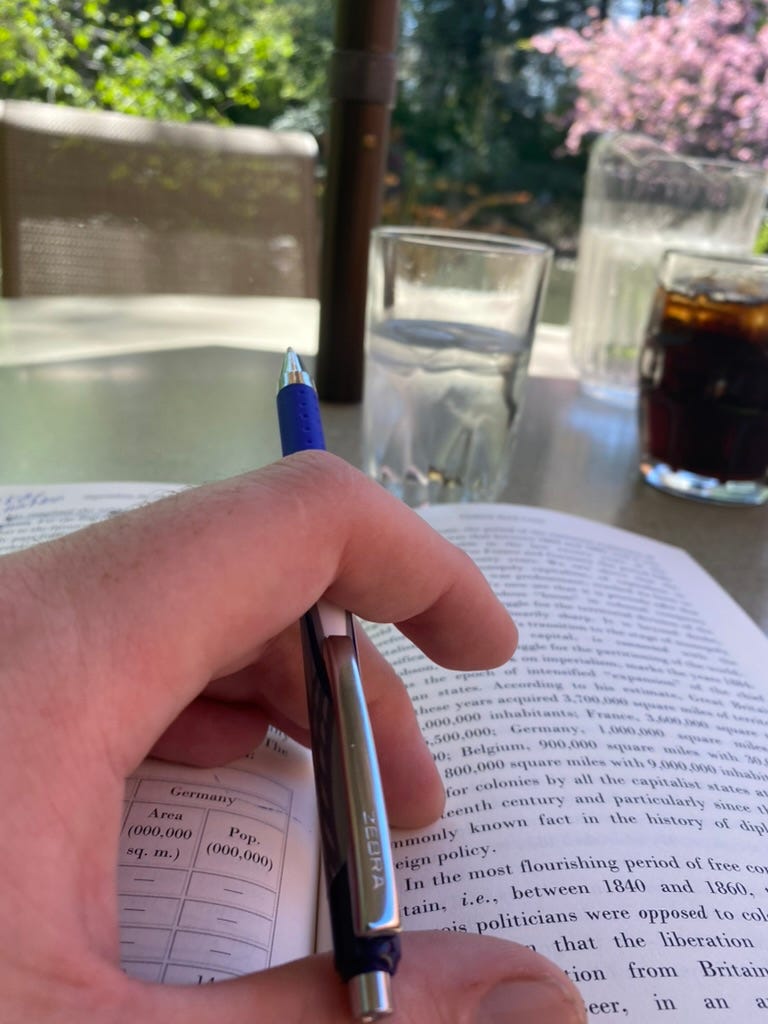
It may appear here that I disdain lunch meetings, and by and large, I do. Both planned and spontaneous ones. At the aforementioned club, I once ran into an acquaintance from the university, and much like George Smiley’s encounter with Roddy Martindale at the onset of Tinker Tailor, I was roped into a performative hours-long ordeal with multiple actors whom I did not wish to engage with. There is nothing so soul-crushing as arriving at a restaurant for a solitary lunch alone with one’s thoughts, a notebook, a pen and an order of prawn tempura only to be siloed into an occasion wherein one must not only answer questions, but ask them. To hijack a writer in his haunt is to derail a day of progress.
Planned luncheons are equally draining for other reasons. Social catch-ups are ideal if planned in advance and the company and location are agreeable. Planned lunch meetings with obnoxiously draining dining guests and agendas of discussion are a poison to the soul. I recently had one of these that carried with it the more egregious caveat that there was indeed a business agenda at hand, but one that I was unaware of before being seated. Spontaneous job interviews over lunch have yet to ever be pleasurable to any such subject in the entirety of human history.
To the storied class divide in the culinary world, I think now to where I have had my most productive lunches, to the haunts that have become or once were integral to my writing process. I will not write there directly, but I will rouse myself from my desk to venture into civilization to exist in these spaces to break the line of monotony in culinary colour. I never plan these moments ahead. They come out of the ether, where at the stroke of 2 pm, I am seized by the desire to whisk myself away to uncover them. Sometimes this brings me to my favourite American Chinese restaurant where, in a corner table, I carry on a conversation with the owner from across the dining room while sipping hot and sour soup, which envelopes my soul in the warmest of hugs while awaiting my entrée.
This essay was born in that restaurant, curiously. I stepped out of the office one fine spring afternoon to treat myself to lunch before returning to work on some of my research when, while seated at my table, I observed what can only be described as a walking gaggle of pure headache enter the restaurant. What spilled out of two brand new and very expensive GMC pickup trucks was a clutch of loud and obnoxious out-of-state boys on their big spring hunting trip. I have since lost the memory of where they were from, but two of them quite literally wore overalls with no shirts and had they been chewing straw, they would have looked like every caricature of the American farmer. I dislike when these types of people come to town because, unlike many of the guests that come through as tourists, the out-of-state hunting boys are always the absolute worst. They are so loud, so intent upon being noticed, and so painfully obviously trying to pretend play some kind of faux working-class Western identity. While it is true that Slingblade and Deliverance wore overalls sans shirts and spoke with country accents, it was also clear that they were not working-class good old boys just up for a spot of hunting for the season. I do not know many people who wear overalls without a shirt, but I do know that the people who have such a look as a genuine identity usually wear it often enough that their tan lines reflect outdoor labour. These two did not even have tan lines along the overall straps and were far too clean and well-groomed to be real salts of the earth. Their $100k pickup truck didn’t lend much to the imagination either.
I am immensely protective of the owner of this restaurant. I have known her my whole life, and she has always taken good care of me and my family whenever we have dined at her restaurant. She used to deliver takeout to me in high school on rare occasions and would always add an extra coconut cookie to the order. As such, I am hypervigilant when I listen to what these out-of-town types say to her when she or someone else who works there takes their order. This is where I got to hear Slingblade offer in a blunt drawl that he would “take” the “Mongol beef no spicy” (assuming the owner, who is from China, does not speak “good” English despite her being fluent in English, Mandarin and Spanish) and Deliverance ordered “the sweet and the sour chicken please, darlin”. I am unsure why these mundanities filled me with such unexplainable frustration, but they did. There’s always a slight hint of condescension in these types, and a lingering aura that as soon as they get back into their pickups, they will most certainly be lobbing some unquestionably racist jokes around. Culinary social class marks us not just in terms of who we are, but how we think, I think. For some reason, this gaggle of performative outdoorsmen stuck with me and I returned to my office and immediately sat down to compose this monstrosity of an avant-garde departure from regular programming. I think the jarring sights and sounds of this spectacle rattled me to my culinary core.
The culinary class divide rears its head in this reality as well, in this town, when I tell people I am opting to eat at this restaurant, their reactions usually reflect some kind of negative opinion. Almost to communicate the sentence “why would you ever do that?” There’s a weird sort of disdain for it that is wholly unwarranted. “You eat there?!” is another refrain I have received before. I am not sure why it is so present, but I have my suspicions. They prefer the upscale, trendier, modernist fusion places for their Asian cuisine. There is a Thai restaurant on Main Street that all of the transplanted locals rave about; it is where nonprofits host dinner celebrations and where the kids from the nicer neighbourhoods go for their pre-prom dinners. This restaurant is not one I have ever dined at for two reasons. First, a childhood favourite of mine used to occupy the space that is now theirs. That restaurant was called The Palomino Grill, and I loved it dearly. They had a carnival carousel horse over the bar and made exquisite chicken fingers to my discerning 12-year-old palate. Secondly, I cannot reconcile the sheer GenX pretentiousness that leaks out of every single corner of this place. It intermingles with a lot of the higher society markers of my hometown that have been imported by newcomers chasing the highs of Outdoor Magazine’s top 10 places in the US to live and work. Including but not limited to: owning a $12,000 mountain bike, living in a sprinter van with a Starlink connection, or sharing vaguely left-leaning memes on Facebook while secretly being pretty racist, earning $90,000 a year working for a nonprofit by never being in your office or doing any real work, and hating on people who came to town slightly sooner than you did. It somehow folds in the soulless millennial burger joint aesthetic with cultural appropriation and something adjacent to the co-opting of eastern philosophies by wealthy white real estate moms. This may be summarized in the following quotation, captured verbatim from their menu:
THIS ISN’T A TRADITIONAL THAI RESTAURANT. WE’RE NOT THAI. NOT EVEN CLOSE.
THE SMELL OF MINT, CILANTRO, PEANUTS AND SHRIMP PASTE, THE RADIATING WARMTH OF CHILIES, THE SATISFYING RICHNESS AND FUNK OF FISH SAUCE, THE ACIDIC SLAP OF LIME...IT’S AS HEARTWARMING TO US AS OUR GRANDMOTHER’S COOKING…EXCEPT, OF COURSE, SHE WASN’T THAI EITHER.
WE ENCOURAGE YOU TO ORDER FOOD FOR YOUR TABLE TO SHARE...EVEN IF YOU DON’T LIKE EVERYONE YOU’RE SITTING WITH.
ALL PLATES ARE SERVED WHEN THEY ARE READY. SORRY, AND THANKS FOR UNDERSTANDING.
OUR FOOD IS ROBUSTLY FLAVORED. MOST DISHES CAN BE ORDERED MILD (OR SPICIER) IF YOU PREFER.
Nothing about this inspires me to want to eat here. It is cringe-inducing, in poor taste and ultimately just sort of sad. It tracks with the previously lamented ego-centred attitude of the beer hall, where my role as a diner isn’t to enjoy someone else’s creation, but it’s to be shocked by its abilities to mildly crest the horizon of mundanity. I was asked once to attend an event here, and I refused on spiritual grounds.
For the diner who does not prefer the edgy GenX attitudes extolling the funk of fish sauce, there is another Asian café offering fusion dishes across town that is quite elevated comparatively speaking. I have less to write about this establishment as I frequent it when I am flush enough with cash to not miss $100 for lunch. They have supremely excellent sushi, a wonderful staff and service, and aside from requiring a second mortgage to be able to afford it, it is a place that I often land at in my writing process. The diners I see here are mostly upper-valley visitors or tourists of a higher class than my overall clad hunting boys. Lunches here are reflective, typically, and I will be remiss if I do not say that when I lived away from home, the thought of their sushi and ginger salads called to me quite deeply at times.
Spicy Maki Combo
You Will Require…
A trip to a reputable sushi restaurant.
Order thusly:
1 Spicy salmon maki roll
1 Spicy tuna maki roll
1 Spicy yellowtail maki roll
Extra ginger
Good light soy sauce or ponzu sauce
Wasabi. Preferably grated fresh, but the horseradish substitute is passable.
To prepare:
Don’t.
You can most definitely make it yourself, but don’t. Go find a good sushi restaurant, go there at 2 pm on a Tuesday, sit at the sushi bar, and if it is not busy, chat with the chef while they work. Tip your sushi chef in addition to your server. The experience of this course is not in your personal composition of it, but in experiencing it in the real world. Do not do this for a business meeting. You are not Patrick Bateman, and the ‘80s are dead and gone. Take a notebook and a pen and never open it. Go with the idea that you’ll get working on that article you mean to write and forget to do it in between bites of ginger-dressed salad and hot and sour soup. Don’t drown your sushi in soy sauce. Eat a slice of pickled ginger between each bite. Grow up from the California Roll and gently fold it into your writing process.
V. Entrée.
Elsewhere, I have written on the sociological and philosophical intricacies of the power of memory to illicit a living experiential reality in light of our own lived historicities. Within these writings, there is the notion that memory, either good or bad, is crucial to our collective knowing of ourselves in the contexts of social experience. Where does the knowledge of what it means to be us come into the discourse of our everyday real life? How does the past shape us into a social actor capable of fording the rivers of the moment and planning for the floods of an abstracted future? It lies in the idea that what we experience shapes us ever so slightly in our conceptualization of ourselves.
This practice of shaping ourselves in memory often, I fear, in my work distances our discussions from the more relatable ideas of memory. Specifically, how memories that are cherished deeply are more than social building blocks of reality and experience, but instead they are the things that carry a sense of warm nostalgia for us, they allow us to look back into storied times of the past and recall things that were better, brighter and reflective of a time when what it took to instill a sense of cozy comfort was so much less than the insurmountable realities we face today. I have written a great deal about how ‘dangerous’ it is to live in memory without a mind to the present or the future, but I have yet to consider the realities of living in memories for only a handful of moments and how this is actually some of the most soothing social behaviour we may engage in.
To recall a cherished memory, it would seem, is to momentarily allow yourself the sense of what it was like to once upon a time experience the lighter currents of the daily greys of life as it goes. There is a curious way in which food does this for us, where the spatial relationship to culinary creations can place us in these moments. Arguably, there are two classes of memories of food that can take us to these warm and cozy locales in our mind’s far reaches of recollection. The homemade meals that draw us into a childlike wonder of stability and safety, among the warmth of youthful nostalgia, and then the moments that have taken us far from home into the milieu of the restaurant.
The place where the world shifts around us in an ordered chaos of creativity, consternation and abject destitution on the best of days. The restaurant is a gauntlet of modern existence, be it a Ruby Tuesday’s adjacent to the airport, or the Michelin-starred boutique bistro along some forested road in the Lake District, the moving pieces of these spaces are modern monuments to the sheer humanity of our species. In no other locale does the combination of our promethean fire, rendered fat, acids and salts come together in the impossible task of creating art for the consumption of others. The industry is wholly its own, partially embraced in the tradition of hospitality, wielding the ancestral blood of the medieval tavern as a warm respite between where we are leaving and where we are hoping to arrive, and partially the painter’s studio open to the public, wherein the efforts of the artist are on display for the immediate consumption of their work. It is a terrifying concept, to open one’s self to the brutality of a dinner rush on a weekend, to balance time, temperature, seasoning and presentation all in the chaotic symphony of one dish after another. There is a music to it among the chaos, the rhythmic hymn of madness belted in close to the roaring gas fires and the clatter of aluminum tools on stainless steel pans. It is a collesuem of gladiatorial combat day in and day out where not only are your adversaries the finely juillienned onions beneath your fingers, but the hearts, minds, stomachs and unquenchable expectations of the eating public. To paint a landscape is to create a moment for others to see, to interpret, to think about in perpetuity and it is done privately, behind the closed doors of our studios with only the green fairies and the fumes of mineral spirits to dampen our resolves, in the kitchen the canvas lives, it breathes, it was once and may continue to be living. There is no time to think about the minute details, the composition of colours, the balances of hues and shadows and contrast, it is instant, here, in the moment. It is closer to photography than painting, cooking is a single flash of light concentrated through myriad lenses into a singular focal backing and the expectation, the hope, the prayer is that once your plates are presented, the image is clear, understandable, and sustaining.
We have evolved beyond the primal need to eat, and instead, now, we may craft food as art, and those that do in between quart containers of water, parliaments and screams into the walk-in void, there is a moment of pure artistic expression. Be this in the commercial kitchen of a chain restaurant wherein one is cautiously assembling endless Triple Dippers for the Thursday night sports fans, or if one is carefully arranging microgreens atop a poached salmon puree, there is always something of a hallmarked creativity to it. There is a pride in that artistic direction where, between the hellish suffering on the line with the burns and cuts and bruised egos that we find something of a peace in our chaos.
For the rest of us, the others, the diners, the ones who fling ourselves into the night in search of good food that creates good memories, we are tasked then to a strange place in this chaotic symphony. We are the catalysts, the initiators, the ones who kick off the whole damn thing. It is not until we are seated, have perused the menu and make our decisions that the whole thing can start. In a clatter of motion it begins, the ten-top with all different entrees, the appetizers, the one substation from seat four that destabilizes the whole rhythm. It is playing a symphony with ten conductors with ten arrangements and for ten different movements to ten individually discerning audiences all at once. We, the diners, occupy this space uncomfortably. Or rather, we should. We are not entering our homes, wherein we may demand foods of the hearth.
We are entering a gallery.
The culture of expectations around this practice is so maddeningly ingrained in our social ethos that they are nearly impossible to ignore. For so many diners, the idea that they are the star of the evening, the show, the production is palpable. There is nothing more important in the entire world than the baby boomer and his buffalo wing appetizer (made with as little spice as possible), according to this diner. He is the centre of the universe in this chain restaurant. He is not only allowed to demand every detail of perfection, but also to sociopathically play mind games with the waitstaff and cooks to ensure he gets his fill not only of carbohydrates and Red 40, but also in the psychotic behaviours of tormenting service workers to his infinite glee. We have all seen these diners. The ones who demand excellence while expecting to pay for mediocrity. The ones who sexually harass their waitresses with off-colour jokes that were never funny, the ones who order a menu item and then demand enough substitutions to change it to an identical menu item that they vehemently refuse to order, the ones who shout for a manager if their $15.00 sirloin steak is not perfectly cooked to their requested well-done. These are the people who poison the experience, who corrupt the subtle majesty of the chaotic symphony to embolden their own sense of worth in their lives. If we cannot feel fulfilled as a car salesman, an insurance agent, a business consultant or a real estate agent, at least we can feel good because we made a 20-year-old waiter cry in the walk-in because he forgot our honey mustard.
I have seen many of these diners in my time, and a partial problem of being a writer of social experience that frequents restaurants is that I hear too many of these boisterous, demanding gluttons in a given visit to a restaurant. Thankfully, the number of these that I have had to share a table with is comparatively low for the number of times I haunt these places, but the ones I have had the displeasure of sharing a building with never fail to induce a collective headache. I think there is an odd misunderstanding of our positionality in these spaces that has a major generational divide at its core. GenX and Baby Boomer types see the restaurant as their personal Roman palace, wherein the sole purpose of the existence of the waitstaff is to cater to their every whim beyond any scope of realistic expectations. I would not put it past these types of diners to demand a waiter fan them with a palm frond if they could get away with it. I cannot fully know what it is like to live life this way, where every other human exists as a conduit to your own hedonism and where every social function is dedicated to your honour. In contrast to these diners, the Millennial and Gen Z people I have shared tables with nearly always feel almost embarrassed at the inconvenience our presence in the restaurant causes the staff. We will ask for what we like, but if our server forgets something we feel sheepish in reminding them because we do not see them as people there to serve us, but as people who are at work at the moment, and we know the realities of being at work to such a degree that stupid questions and entitled customers are the ones we most despise and most desire to distance ourselves from. We are the types of diners who come in 90 minutes to closing, already apologizing and then with reassurances from the staff, we stay, eat as quickly as possible and stack our dishes and wipe the table down.
This dissonance in diner existence colours the experience of the memory of these places. The aged diner will lash out on social media and within their friend groups to the ends of the earth to ensure everyone knows that they did not like their server at Golden Corral, where I find very few younger diners even take part in the process of sharing their restaurant experiences unless prompted. There are a select few nightmares among us who have fallen into the delusion that Yelp is a social networking site and that their reviews are not only needed but so worthy of the rest of us reading them that they make them public. I had the misfortune of meeting one of these once, and it still haunts me. It was oddly not in a restaurant but in a graduate-level class on the subject of race in American public schools, and this prolific Yelp reviewer very much did not like me for having the audacious inclination to approach race in education from an intersectional perspective, but I digress. Once in a rageful internet deep dive, I found his Yelp account, and what followed was nearly an hour of reading the most pretentiously entitled restaurant reviews I have ever seen. Compared to these, the pretentious faux Gonzo Aspen Times article about Food & Wine was Pulitzer Prize-winning material. To see a twenty-year-old absolutely deconstruct the disruptions in service at a 24-hour chain diner to the very minute details (something to the effect of how they did not like “SYSCO” branded flatware) rewired my understanding of the world. I did not think people like this existed outside of movies, but there it was in the folds of Yelp reviews of doctors’ offices and hotels and pizza places that there was someone my age who quite clearly could never be pleased by the actions of another human being. I cannot imagine that way of being where you do not allow yourself to make good memories of the places you visit because you are too focused on dissecting the less-than-ideal temperature of your 3 am mozzarella sticks. I cannot imagine letting such minuscule things so negatively reorder my experiences to such a degree that I cannot ever seem to find happiness in my travels.
It is the real skill here of the diner, the traveller, the guest, the ones who experience service, that we can very easily endeavour to find a way to appreciate what we are experiencing without the need to dissect every single detail and compare it to impossible standards. Standards, when too exacting, are dangerous things, being primarily the sources of most of life’s disappointments. They are similar to expectations, although I think there is a difference somewhere there in the milieu of nuance. Both play in shades of reason where it could be argued that there are reasonable standards and reasonable expectations. It is reasonable to expect the food you eat to be cooked properly, to expect your cooks’ hands to be clean, and that you will enjoy your meal. It is also reasonable to have a certain degree of standard to idealize in your patronage of the restaurant. You can have a baseline for what a given meal ought to be, and so on. Where the line becomes murky and more damaging is, like with most things) outside the realm of reason. To expect the 24-hour diner in a college town to serve you Michelin-quality A5 Wagyu, and to hold this dusty and dimly lit greasy spoon to the same standards as The French Laundry, then all this does is perpetuate your disappointment. This lesson transcends tasting menus and late-night waffles. If we hold our experience of life to some impossible standards and season them perfectly with unreasonable expectations, we end up flowing in an endless stream of disappointments. In life as in the restaurant, to throw caution to the wind and excuse our sensibilities to allow a floating freedom in our movements, the surprises more often than not are more rewarding than the old staples or our wildest expectations. In both life and food, if we embrace the sense of adventure in our tastes, if we forgo our expectations and adapt our standards to a sense of seeking pleasant surprise rather than perfection, I think we are more situated to experience both the treats of life and the flavours of our dining experiences in far more authentic ways.
Pacific Northwest Warm Steak Salad with Bacon Balsamic Vinaigrette
A Heavy Dinner Masquerading as a Light Dish
***
Serves six
You will require
2lbs/1kg Flank Steak
1lb/.5 kg small potatoes, either gold or red
Large sweet onion sliced into rings
8 oz./226g Baby Arugula
A teaspoon of ground dried rosemary
A Teaspoon ground dried thyme
Salt and pepper to taste
Olive oil
For the Dressing:
1 Cup/236ml Balsamic Vinegar
1 Cup/236ml Apple Cider Vinegar
½ Cup/ 200g Sugar
1lb/ ½k American Smoked Bacon
1 Large Sweet Onion, finely diced
Cracked pepper
Salt
1 Tbs Corn or Potato Starch mixed into a slurry with 1-2tbs of water
To Prepare:
Preheat an oven to 400 degrees Fahrenheit, 205 degrees Celsius, or gas mark 6. Remove steak from packaging and pat dry. Coat with olive oil and season well with salt and pepper. Optionally, you may also add a small sprinkling of Caldo de Res powder or smoked paprika. Place in a safe counter space and allow to come to room temperature. Halve, then quarter the potatoes into small 1-inch bite-sized pieces and add to a mixing bowl. Coat in olive oil and season well with salt, pepper, rosemary and thyme. Alternatively, you may use good butter in lieu of olive oil, and you may add whole cloves of garlic should you desire. Pour potatoes out onto a half sheet pan and set in the oven to roast, stirring and turning occasionally for 45 minutes to an hour. They are done when fork-tender and have taken on a crisp side. Slice one onion into large rings and place in the same bowl as the potatoes, and toss with olive oil and salt and pepper.
Pre-heat the grill to high heat and place a sheet of aluminum foil over one burner or over one quarter of the grill. Pour the onions onto the foil and stir frequently while searing the steak. Sear the steak for 2.5 minutes before rotating ¼ turn for grill marks and then another 2.5 minutes. Flip and repeat. Stir the onions between each rotation. Once seared, reduce the grill heat to low and flip the steak. Allow it to grill on low for 6 minutes, placing the onions on top as it grills. Place the onions back into the foil and flip the steak and grill for a final 6 minutes. Return the onions to the foil and wrap to secure. Place the steak on a cutting board lined with two sheets of foil and wrap tightly. Bonus tip: lightly sprinkle flaky salt and cracked pepper into the base of the foil before placing the steak down to rest. Allow the steak to rest for 10 minutes before slicing thin on the bias.
For the dressing:
Finely dice the bacon. Place it in a cold large saucepan on medium heat. Render the bacon fat slowly and cook the bacon until it is crisp. Remove the bacon to a paper towel-lined bowl to drain. Remove half of the bacon fat and set the rest over high heat. Add in your finely diced sweet onion along with a pinch of salt and pepper. Sauté the onion until translucent and mildly coloured. Carefully add both cups of vinegar and the sugar and bring to a low simmer. Allow to simmer and reduce slightly to allow for the acidity to fade. Add back in the bacon and simmer for five or so minutes. Stir in the starch slurry and mix until a desired thickness is achieved. Remove from heat, cover and reserve.
To assemble the salad:
On warmed plates, arrange a serving of washed arugula. Arrange a serving of the roasted potatoes on top of the greens. Drape the grilled onions over the potatoes and greens, and then layer a serving of steak slices in the centre of the salad. Steak should be ribbon-thin and cut across the grain on an angle.
Dress the salad with the warm vinaigrette, treating it more as a pan sauce than a true salad dressing.
Serve immediately.
Best enjoyed in company, in the spring, al fresco
VI. Salade.
Celebratory meals have fascinated me for a long time. I think this is because it is a dual social function, it is the sharing of moments and experiences on the basis of sharing food, and it also elevates the dishes served to something special. I am not referring here to meals that take place is swanky swinging hotspots, or ones served for holidays or at special events. I am more fascinated with the home cook’s special occasion meal. The homefront’s special day. Be this one shared by a family to honour a milestone of life, one shared in seclusion to mark a special day, or other such experiences wherein the mundanity of meal time evolves to an elevated experience. I became further fascinated in the diversity of what constitutes a special meal and how different that is across family tables. This fascination comes from a very unlikely body of media: cooking utensil infomercials from the 1990s and early 2000s. I have long enjoyed watching these hour-long advertisements for cheaply made products, even when I was a kid. Something about them was always so encapsulating. I cannot say that as a child, I was thinking I needed a Magic Bullet or an Xpress Redi Set Go or a NuWave Oven, but something about the staging of these television productions has stuck with me.
In hindsight, I think I was attracted to, or rather soothed by, the stark utopia of these productions. There is nothing but positivity. Infinite good things to say and the entire story centres around the creation of food, not just for ourselves, but always in an entertaining or family setting. The presenters of these shows also exuded their own brand of turn-of-the-millennium positivity. Names like Mick and Mimi of the Magic Bullet show (shown serving breakfast after what appeared to be the most insane swinger’s party of the decade) or Joe Fowler charismatically expressing unstoppable joy over the power of a given device’s ability to cook a chicken breast from frozen to perfection in just 9 minutes. Cathy Mitchell reigns supreme as the undisputed queen of the infomercial. Under her red curls and calm midwestern grandmother presentation style, a viewer was captured. Not by the glorious benefits, convenience and cookery science of MicroCrisp or the Xpress101 but by the scene of a genuinely caring woman talking about how her cinnamon rolls in whatever machine still bring her kids running downstairs on a Sunday morning. I am certain her children, by the later shows she produced, were well into their thirties at this point. She demonstrated the electric countertop hotplates’ ability to combine pizza dough and leftovers into personal pan pizzas, great for hungry teens after school, while showing us as well that asparagus wrapped in steak with no seasoning was the perfect elegant meal for one. Her shows are comforting because it feels like your grandmother is there teaching you how to make no-flip omelets before the world faded into the grey madness it is today. I have never followed any of her recipes, although the idea of making a chocolate cake with diet cherry cola is still something that haunts my curiosity to this day.
My fascination with the celebratory meals of the homefront comes from these shows, not because they expressly demonstrate a celebratory meal, but because the elegant and elevated dishes they showcase in their product demonstrations reflect my own lived experience in the late 1900s and the early 21st century. These are dishes I remember seeing being popular in these weeknight family celebratory dinners growing up, and it seems that once a dish was sort of ‘settled upon’ by a given family, that was their ‘special occasion dinner’. As a kid at various friends’ houses, I had samples of Shake N Bake chicken drumsticks, chilli, one horrific trout dish, and the staple of ordered-out pizza. My own family’s was shish kebab, which did seem to figure quite prominently in these informercials, although of my family, I appear to have been the only one who did not automatically change the channel when Cathy Mitchell and Joe Fowler came on…
This myriad of celebratory foods is interesting not for their composition, but for the unique process by which they are elevated to the tier of special occasion foods. Sometimes such dishes are not out of the ordinary for the dinner rotation, and yet when combined with a milestone or achievement, they suddenly become special. That process intrigues me most about these homefront micro holiday meals, and I feel they are quite encapsulative of the human experience. We are unique in that we can and often do craft our own intricate traditions and holidays around the milestones we reach. There is something warm and comforting in the idea that a meal can become special, or that a special meal is shared, or that it is marking an important moment. Birthdays can be close to these holidays, whereby birthdays, especially as we’re growing up, are important milestones, but I think of the smaller ones. The last day of school, passing a big test, graduatingfrom university, anniversaries, or other such occasions. These are some of the more human moments where we share meals together. They blend that utility and sociality as previously explored, but in ways that mellow the utility across the class divide. A birthday dinner can be something less than practical if it is special, and so on.
I also believe that there are differences between meals shared out and meals shared at home. It is nice to go out to a restaurant for our birthdays, sure, but how does that compare to doing it at the family table? There are different dynamics there, somewhere that also can mean that the dishes shared, irrespective of quality, become quality on the basis of who’s at the table.
One such micro holiday I can recall from my childhood involved the Olympic opening ceremonies. As was a tradition, we as a family would move our dining table to our living room near the television and cook a special dinner of shish kebab to watch the opening ceremonies in either winter or summer. I cannot say that this memory is something I am particularly nostalgic of, I do not really care for the Olympics now, and I did not then, but something about that experience of dressing up on a weekday evening to make a sort of evening soiree of viewership is quaint to me. I think too, that the circumstances of these meals are what made them special. While the food was good, sharing it in a new setting with sparkling apple cider and an engaging program with my siblings and parents was what made such occasions special. I do not remember each opening ceremony; curiously, I remember the closing ceremonies in far more vivid detail. I recall watching Ray Davies play Waterloo Sunset at the end of London and Neil Young playing Long May You Run in Vancouver.
Other celebratory meals I recall have far more exuberance than grilled meats, rice and vegetables around the Sanyo television set. Once, on a venture to a classmate’s birthday party in the wealthy, nearly-gated community in my hometown, after a day of water gun wars and party games in the yard, we retreated to the back yard for what I may only describe even now as the most surreal home dining experience I have ever witnessed. We were told in our invitations to bring tropical resort wear (which was very indicative of the host family for this event having the expectation that kids in rural Colorado would simply own resort casual attire). I would later learn that of my peers, I was seemingly the only one who did not have my cruise ship outfits pre-planned. After we had dried off and warmed up, we filed into the backyard lit only by tiki torches, with soft Hawaiian music on the boombox and came to find what essentially was a tropical outdoor restaurant for our enjoyment. The host (the kid’s dad) greeted us, seated us at various tables (curiously, all the cool kids sat with his son while the rest of us languished in the wings), and handed out menus.
The evening was organized into three or four courses, and the items available for order all possessed tropical code names. Items such as “a clamdigge,r” or a “trident” or “seafoam” or “Big Island Chicken” or “seaweed” were listed in fancy fonts on thick pale blue cardstock. We were told we may order only a limited number of items per course, and our wait staff (the kids’ parents) refused to offer explanations or clues as to what each item was. We would each relay our order, which was written down, and our hosts would disappear into the kitchen to prepare each course. These items, we would learn, were not always foodstuffs. The clamdiggers were spoons, the tridents forks, etc. Seafoam was a frothy lemonade pina colada adjacent beverage (alcohol free, we were seven, they were Mormon). This made for a random dining experience. One kid would get a slab of teriyaki chicken (which was very well made), a pile of nori and a glass of lemonade foam, but no utensils, while their neighbour would get a fork, spoon and a pile of seaweed. Each plate was different and each course, via process of elimination, became more knowable. Somewhere in the intermingling sensory experiences of the smell of tiki torch fuel, the sounds of slide guitar and ukuleles and the Hawaiian shirts and conversation, this experience was the closest I have ever felt to the songs of the doomed Hunter discussed in The Rum Diary. We were, in the middle of American suburbia, transported to a culinary and cultural experience thousands of miles out to sea. It was, in the truest sense of the phrase, magical.
I remember this dinner vividly to this day, and how the wonder, the mystique and the sheer whimsy of it made for such a creatively wonderful shared experience to celebrate one of these micro holidays of an 8th birthday. At this time, there was a sort of underground birthday cold war between mothers, it seemed, where everyone tried to outdo the others in the trenches of party planning. Themes were ever-present and reflected the times. I must confess that my 8th birthday (a pool party with a neighbour girl who shared a close birthday to mine) was unfortunately Harry Potter themed, but mine was not the only such travesty in the early 2000s and now, just no. Interestingly, that party was apparently memorable enough to a kid in my class that a decade later in high school, while lacing up our shoes for gym class, he remembered it even then. My favourite of my birthday parties during this cold war was a pirate-themed one my mother and father organized when I turned seven. I had always liked pirates as a child, thanks in part to Fisher-Price and their to-this-day super cool toy pirate ship. In preparation for the party, my dad built a giant wooden chest and filled it with plastic gold coins, goodie bags individually sewn by my mom containing little plastic pirate figurines, chocolate coins and rubber eyepatches, etc. He then went to my grandparents’ property out of town and, in front of a solitary tree, buried this treasure chest five feet underground. From the tree, he hung a model skeleton in a pirate’s hat borrowed from the EMS supply closet at the firehouse in town. My mother, a true artist, drew a map of the entire 8 acres, complete with trails and landmarks. The map, on parchment cardstock, was then soaked in coffee and burnt at the edges. The corner with the “X” that marked the spot was surreptitiously torn off…
Clues were written and nailed to trees, hidden under rocks or in books in my grandparents’ log cabin, and when my classmates and cousins arrived with shovels, we struck out on the grand scavenger hunt to locate our buried treasure. Over the entire day, we scoured the juniper woodlands of my childhood to find the clues and to decipher them. By midday, we were digging frantically under the shade of the tree and finally, after long last, we found what we sought. For lunch that day, I believe we shared pizza from the best pizza shop in town (for my local readers, it was Peppinos, not White House, while White House is good, I always feel it’s a bit too hipster). I do not remember that meal, but I remember the legends around me that led us to that victorious banquet. Being that I do not have children, nor plan to, the closest to a birthday party cold war I can feasibly get to is being more and more extravagant for my dog on his birthday. I don’t consider my dog to be my child, but I will be damned if I do not make him a ‘special’ dinner on March 24th each year. My go-to for this is homemade oatmeal peanut butter dog biscuits and a multi-layered meat and vegetable pie. It’s the least I can provide. I will also note that if the above birthday celebrations seem exorbitant, I agree. But rest assured, as my younger siblings are twins born within a few days of my other younger brother, suddenly their birthweek became a bit busier than my faraway spring arrival. I hold no contempt for this reality, but it is one I feel compelled to share.
Also, considering my lack of offspring, I am unsure if the themed birthday party arms race is still roiling between parents of the modern-day child. I know that the gifts have changed considerably. On that pirate day, the most cherished prize I received was a bright red, Sesame Street-themed Kodak 110 film camera (with built-in flash!) from my grandmother. Over the decades, it was lost in moves or decluttering or the rise of digital cameras. Somehow, my dad found a new one, and that comprised my gift a few years ago and it brought tears to my eyes. A friend remarked that I didn’t need my Leicas anymore because Elmo was going to furnish my kit for photojournalism from then on. I haven’t the heart to open the package, but I am curious if the Kodacolor 110 film is still good or not…
Not all birthday meals have been good, and I would be immediately suspicious of anyone who would say that theirs have. They’re either too boring or a liar. Some of my worst were always spent in my own solitary company. I turned 22 while stretched out on a camp bed in room 106 of a now-demolished psychology building at my undergraduate alma mater, and then spent the day working on research in my office before having dinner with my dad, who had driven five hours to bring me some takeout. Later that evening, I resigned to the largest lecture hall in the building with a glass of Jameson gold reserve and watched Alien Resurrection by myself (an underrated film in the franchise). Others have been bleaker. The last birthday I celebrated in Canada, my now-former partner left halfway through dinner to cheat on me and didn’t return for three days without contact. My dog and I watched the Royal Tenenbaums, walked around campus and then went to bed. Birthdays spent alone are weird things. We are meant to make them special, but then I think a lot of what makes them special is the efforts and experiences we share with others. So long as we are with people we care about, the smallest gestures elevating the simplest of things to the category of ‘special occasion’ can mean the world, be they an elevated weeknight dinner in the living room to watch the Sochi opening ceremony, or a mildly damp piece of cranberry crisp with a solitary candle shared between friends in the Scottish highlands, these moments define our memories as particularly warm ones. And illustrate that food, when elevated to special can be much more than just food.
Seafoam Salad
In the traditional American sense, that any mixture of foods is a salad, even if the constituent components are all dessert items. Dessert salads are not dessert, but rather they are their own category of overly sweet neon coloured side dishes meant to be enjoyed or entertained at gatherings.
You will require:
Two 15oz/420g cans of pear halves (reserve the liquid)
One package of lime-flavoured Jell-O mix
One 8oz/225g package of cream cheese, softened and at room temperature
Two tablespoons of milk
One 8oz/225g container of thawed frozen whipped topping (in America, this is called “Cool Whip” it is a nondairy chemical monstrosity that resembles whipped cream but is shelf stable and does not separate. It is also lighter than whipped cream. It comes frozen and is often served in lieu of whipped cream. Its containers are regularly reused as leftovers containers. It is the whipped cream equivalent of margarine as a butter replacement.)
Preferably a whimsical Jell-O mould
To construct
In a small saucepan, heat 1 cup/236ml reserved liquid from the canned pears to boiling. In a large mixing bowl, empty the packet of Jell-O and pour over the boiling pear liquid. Whisk until dissolved and the colour becomes as radioactive as Reactor Number Three at Chernobyl. In a separate bowl, whip the cream cheese and milk together until smooth with a hand mixer. Pour over the gelatin mixture and slowly blend it in until the mixture resembles a seafoam green colour (Pantone 12-0313 TCX). Place in the refrigerator to partially set until thickened (20-30 minutes). In a separate bowl, mash the pears until they are smooth. After the mixture is partially set, fold in the thawed whipped topping and the mashed pears gently until fully combined. Pour the mixture into your mould (that has been lightly greased with cooking spray) and allow to set in the refrigerator for 2-3 hours until fully set.
To Serve:
Dip the mould into warm water for 5 seconds and then invert onto a serving plate, preferably a large round or oval plate that is made of clear glass with a pattern. You may optionally top with whipped cream and maraschino cherries. Remember as well that this is a “salad” by American standards and should thus never be served as a dessert.
VII. Fromage.
Meals equally as meaningful as those of the micro holiday are those spent in isolation. I am of an age when the idea of ‘normalizing’ the act of eating alone was, for a time, internet discourse in either Tumblr textposts or their screenshotted reposts elsewhere. There was an idea, growing up that restaurants were where you went with people and the idea, at least at the time as children was that eating alone in one was a bit of a far cry concept. Discursively, the idea was somehow regulated to some depressing reality of being ‘forever alone’ or without a companion with whom you may share your meal. I confess that I fell into this idea to an extent before my adult life became one where times spent by myself, far from home and far from people I knew, often landed me alone at the table. There is a curious mixture of experiences that comes from the solo interloper in the restaurant reality. Around us there are celebrations, yes, there are business meetings, there are first dates and final dates, a child’s first meal out, a couple’s weekly routine, a student’s reprieve from their dining plan beside their parents. Each of these tends to contribute to the cacophony of noises and experiences that surround us at our outstation islands in the milieu of the dining room.
To compound this experience further, I feel there are variations in the experience that hinge on where specifically we are eating. When I venture from my mountainside hideaway to town for a sushi lunch or a solitary bowl of onion soup in the inn, I feel it is a different experience than some of the solo meals I have had while on my romanticized swashbuckling journalistic forays into the wider world beyond my hometown bubble. In my earliest international foray as a solo diner, I was in the exotic locale of Vancouver, BC. I say this tongue-in-cheek, as while it is indeed another country, Canada has always felt like a second home to me. On this trip, which took place near the end of my master’s studies in Oregon, I travelled with a group of twenty undergraduate students to learn about Canadian culture. Our first stop in Canada was at a Swiss Chalet, an upper-middle-class Canadian rotisserie chicken chain restaurant. I was told then, and the sentiment has since been reinforced, that such a place primarily still exists so that the churchgoing crowd has a facsimile of a “fancy” dinner to go to once the Sunday responsibilities conclude.
What struck me the most about this experience was not the food, nor the atmosphere, nor any other part of the dining experience itself. What struck me was the awe, the wonder, the magic ascribed to this middle-of-the-road place by my travelling comrades. A majority of these people were second-year undergraduate students who had never left the state of Oregon before (as is commonplace there, Oregon is a strange and foreign locale all its own). They marvelled loudly and extravagantly over the quality of the food. Loud “mmms” punctuated the palpable buzz of these 20-year-olds learning they can order a Molson because BC’s drinking age was 19. They acted as if this were some gourmet meal served at the Ritz in Paris, not mediocre rotisserie chicken with vinegar-based gravy (I do not knock Chalet sauce, it is a staple of any pantry).
They treated the food as if it were a curiosity, something mysterious, foreign and wholly new to them. Rotisserie chicken and potatoes did not excite my palate as they did theirs. I do not share this to establish a sense of superiority over some of these people (that was confirmed in our two-week journey together without my hand), but to say that it is always amusing to see yourself situated in the reality of the world when you come to compare yourself to others who have yet to step into it. One of our assignments in this expedition was to seek out new foods we had never tried before, to push our envelope, to test our mettle in the culinary world. To me, this was a challenge; to others, poutine more than achieved this goal for them. To the rest of the world, poutine is a French-Canadian invention where, upon a base of French fries, good-quality cheese curds are layered and then par-melted with hot brown gravy. In more adventurous locales, the toppings and sauces change drastically. I had made homemade poutine numerous times before this venture, and so I was not shocked at the concept. In Vancouver on Davies Street (also a thriving queer district), there is a shop called La Belle Patate which serves traditional Quebecois poutine along with other flavours. The day we arrived, I had initially planned for an order of smoked meat with mustard on my poutine, but they were out. Instead, I ordered the maple-glazed poutine with Irish bacon and a spruce beer. To my readers from outside Canada and to the ones within Canada that have yet to try this French delicacy, spruce beer is a sugary soda made with either artificial spruce sap flavour or real spruce sap. It is the most refreshing liquid to drink on this planet. Doing so places one’s mind in the centre of a spruce forest as the mists roll up the valley to the clearing. It is sublime.
Those companions of mine who thought poutine would be drastically out of their comfort zone were not disappointed. Many thought it was too weird and gross and never completed their dishes.
It was hard for me to write that component of the assignment. What could I find that was ‘beyond’ the range of my palette? Not much, having always had a strong love of spice, Asian and Middle Eastern cooking, various methods of preparation and no real strong dislikes of food beyond the occasional raw tomato or under- or overcooked mushroom. For this assignment, I instead wrote about the joys of being in a large enough city to find dishes I had either had to make at home or that were rare to find elsewhere in the US. During this trip, I once wandered across downtown Vancouver and found myself in a restaurant that served Libyan Aseeda. Aseeda is a boiled dough dish common throughout the Arab worl,d and it is one of the most unique things I have ever enjoyed. I cannot remember the exact preparation I tasted in Vancouver, but I know that my favourite ones often are topped with a mixture of ghee and either dried dates or date syrup.
In this foray into the North before I took up residence in Victoria, I went to have another slew of solo meals in the Donair shop near the hostel we were staying. I have always enjoyed a good Donair shop, especially ones that make their own garlic sauce and have bottles of chilli oil on the tables. I frequented this particular shop many times over those two weeks and was friendly with the staff. They were often open quite late and given my nocturnal tendencies, I would come down the stairs of our hostel, filter into the Irish pub next door and have a mostly passable pour of plain before a smoke outside and finally a retreat to the fluorescent lights of the Donair to sit at the back table with my plate. On my last day, the owner gave me a business card to remember them by.
Oddly, some years later, I was in the same neighbourhood of Vancouver with my then-companion to see a concert by the Paper Kites, a favourite band of mine, just up the street from this shop. When I put in my order, I told the man at the counter that I was glad to be back, having loved it so much some years prior, stating I came in every day for two weeks. The owner, an older man heard this and I cannot tell for sure if he did recognize me or not, but when I picked up the bag of food at the end of the line to go back to my hotel I realized that in the bag were three boxes rather than the one I had ordered. Inside were two boxes of the mixed grill platters, each with extra garlic sauce and a third massive salad. That came to be our dinner that evening as my companion had foolishly only purchased himself one small slice of pizza for the entire evening.
This said, the meals I have come to love the most are those taken on my various swashbuckling jaunts across Europe as a faux foreign correspondent journalist. Be these Lithuanian cepelinai in a café off Pilies Street in Vilnius as I wrote about the war in Ukraine, the Kepta Duona (fried bread) I shared with Lithuanian professors in a pub in Klaipeda as we discussed the finer points of the odd reality that was the fact that Hannibal Lecter somehow was Lithuanian, or the Thai marinated steak tartare I ate in the Hotel Atrium in Paris the night before returning home from that whole ordeal. Each time, these meals solidified a feeling I love very, very much to feel in my travels. Being an included outsider. There is a sentiment expressed in Wes Anderson’s film The French Dispatch by an expat journalist that all those who leave home seem to be looking for what is missing, and that in many such places as foreigners we are always aware of our outsider status, except for the fact that at any given restaurant there is a table, a bottle and a plate laid out for us where for the briefest of times we may come to see ourselves as in a facsimile of home. I have felt an empathy with this sentiment ever since I first heard it, and I have felt that feeling across many tables in my time.
The solo meals in the airport bar, the hotel restaurant, the street-level café, the bistro, these are the times that situate the sense that the writer requires a table, a chair and a meal to really be a writer. Maybe not a “home” bar as Hunter or Hemingway had, but definitely a place to exist as a writer, wherein we may also find something to carry us on over to the next stop. This need not be a restaurant, as sometimes the act of cooking for one in some faraway place is what is required. During my self-imposed solitary confinement in France after suffering the shouting wrath of the owner of the residency, I stole away from my village cottage to the grand chateau that housed my comrades to seek out what food I could to stave away the hunger that came from detaching myself from the group out of fear. I came upon a sheet pan of roast beef, some potatoes and the staples of bread, butter and the like. In the refrigerator of my cottage, I had a small block of butter, a half-liter of milk and salt, pepper mixed herbs. Upon sampling the roast beef to find it was entirely devoid of any semblance of seasoning, I returned to my isolation and in the lonely sauté pan on the hot plate I made what I may describe as the best steak au poivre I have ever consumed.
It’s hard to pick a favourite solo meal on the basis of the food I consumed, because I think the significance of these meals comes from the feeling of who I was at any given moment in their consumption. In Paris, for instance, I had come off of a month of barely eating, entrenched in my writing, making new connections, and surviving the wrath of the wealthy residency owners. After a pleasant train ride to Paris, tearful goodbyes and hugs all around, I was somehow saddled with the task of ferrying a less-than-capable fellow traveller to their hotel at the airport at my own expense, as they were unaware that US dollars don’t work in Parisian taxi cabs. Two hours and two hundred euros later, I crashed into the Atrium Hotel near Charles De Gaulle after a pleasant enough conversation in broken French with the taxi driver. Before reaching the front desk, I noticed rather angrily that the metal cigarette case I often carried everywhere, that was originally made in a jewelry plant in Riga during the Soviet era was unfortunately left on the seat of the taxi full of Camels. Cursing my own indiscretions, with a leather duffle bag and battered typewriter case in tow I made it to the front desk and began to check in, being thankful that my rusty French was discardable in the interaction. While presenting my passport to the concierge, he looked at my hands and asked me if I liked tattoos, as my hands are covered in a smattering of them. I laughed and said yes and he asked me why I was in Paris, which itself was a majorly existential question at the time. I told him I had been there for an art residency, and he then asked me if I was an artist. “No” I said. “A writer, and a journalist.” He smiled and offered some pleasantries at this and gave me my room key, remarking that the restaurant would remain open for the next half hour should I need dinner. In keeping with the good natures and manners I had absorbed growing up in and near Aspen, I knew that my attire at the moment was ill-suited for dinner in a Parisian modernist hotel. Upon reaching my room I changed out of my travel clothes, raw denim and canvas jeans, a near-threadbare sweater, neckerchief, a light down vest and my now-ubiquitous distressed mustard yellow leather jacket into a black dress shirt, black jeans and clashing white linen blazer. I returned to the restaurant with 20 minutes to spare and barreled through the buffet options so as to not inconvenience staff preparing to clear them away. As I sat down the waitress took my drink order (a coca cola and plain gin on the side) and when she returned she said “Monsieur, the hot foods are still served if you would like quickly,” and so I made a mad dash for the roast chicken needing something else to augment the cold selections on my plate. Being that there was only a few minutes left in service I ate faster than I ever have before. Partially out of politeness, partially out of desperate hunger. When she brought me my bill and I paid, she asked if I was a journalist and when I asked why she said because I ate like one. To date, that has been the highlight of my writing career. Pulitzers be damned.
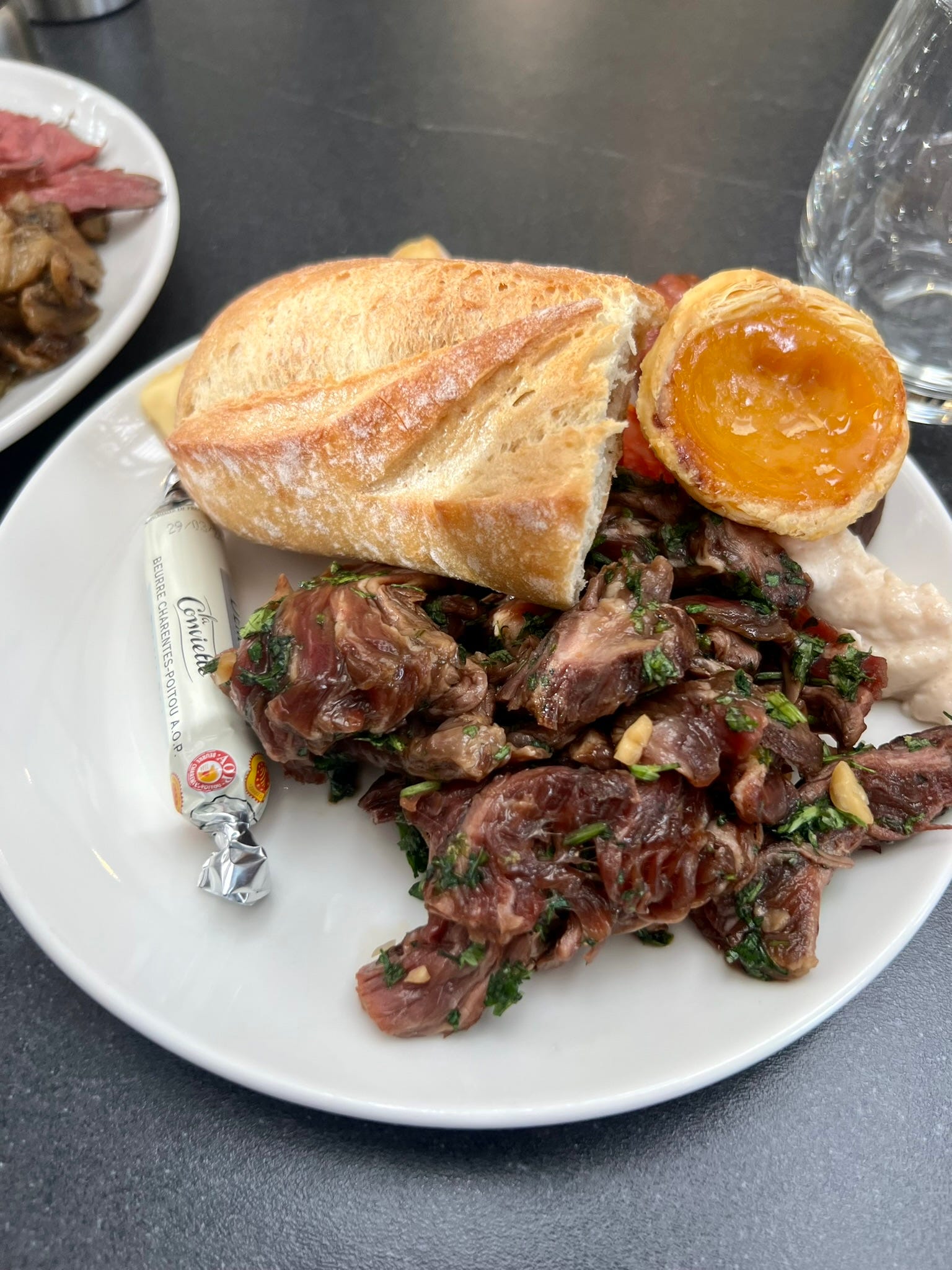
I think more now on that conversation than I did initially. Why would she say that? The real answer is that the concierge no doubt told her I was having dinner but even then, is there a stereotype that journalists wolf down food with no stopping to breathe? Do we do it lest we miss a story? Is it because we’re so drawn out on all-night sessions at the keyboard without the time to feed ourselves? Is it because our constant diet of coffee, cigarettes and alcohol often leaves us crashing out after 48 hours, realizing we need something more than substance abuse to keep us going? I am unsure.
I think of works by other journalists I have read, not about their subjects they covered, but about their lives covering those subjects. My dear old neighbour Hunter surely had a diet about his process and in-between anecdotes about the myriad illicit substances, there are conversations on hasty and large meals taken in tropical hotels or the Red Onion in Aspen. I cannot recall meals discussed in Dispatches by Michael Herr, which is one of the most significant journalistic books in modern history, but I would imagine somewhere between Hue City and the fall of Saigon, he would have scarfed down a C-Ration somewhere along the line. I think of fictional reporter Jerry Westerby as he traipses across Hong Kong, Laos and Cambodia in the LeCarré novel and how even this fictional reporter doesn’t seem particularly concerned with eating on the job.
I think there’s something fleeting about correspondence work that is a unique setting from which to write. I have yet to be a true war correspondent and so I cannot speak to combat meals out on the wire, but as a correspondent submitting dispatches back home from abroad, it is a reality that is tantalizing to the writer. It is, I think, the last true bastion of glamorous writing still alive today. A kind of lifestyle where you must have your wits about you as much as a strong sense of curiosity, and the trust in yourself and wanton abandon enough to fall into stories as they develop around you. Nothing is as empowering to the writer as a press card, a camera on a leather strap, a reporter’s notepad and the knowledge that your job is to go out there and find something interesting for the folks back home. Sometimes this emerges as a thirty-minute chat with your housekeeper in the French countryside, sometimes it comes as an ad-hoc interview at a café with a 19-year-old Lithuanian soldier and his parents, and sometimes you strike up a conversation halfway in English, halfway in Russian with a former soviet postal clerk in the town square. In every case, the intrigue is waiting for you out there around the corner and wearing the “PRESS” badge is as much an invitation into the madness of the world as it is a gateway to its wonders.
The last event for my paper I attended was outdoors in the rain, and I wore the vestiges of my role in that circus on my shoulders. I wore my press jacket, a faded olive drab field coat with a bright blue reflective “PRESS” label on the back and matching olive drab breast pocket patches displaying my surname and the word “journalist.” Have I had occasion to wear it in the trenches? No. But does it lend a mystique to the foreign correspondent in the hometown get-together? Of course. While sitting at a table that evening, sipping a pineapple-flavoured seltzer water, one of the paper’s new staffers introduced herself to me and asked what my role was. I jokingly said my job is to travel to faraway and sometimes dangerous places to write nonsense. Halfway joking, halfway serious, as I remember a particularly tense moment in Vilnius when suddenly news broke of Russian nuclear weapons being staged 30km away on the border, just weeks before a planned NATO summit, and some of the reporters I had befriended in a hotel bar said that it may be the moment Putin moves in. That’s the closest I’ve trodden to real warfare, for now. Even so, the foreign correspondent can encounter surreal warfare wherever their tired feet may lead them. It is upon us to seek out these little surrealisms here and there and to share them with as much countenance as we may muster. If we cannot all become globetrotting members of the press corps, what we may do instead of this life is to consider ourselves interlopers in our own situations, however deeply we may be able to manifest this identity.
At the end of the day, it isn’t the food specifically, but it’s who we are when we sit down to eat.
Savoury Caramelized Shallot and Brie Pastries
For Autumn Afternoon teas.
You will require:
17.3 oz/490g Frozen puff pastry, thawed and cut into nine rectangles
½lb/226g Triple cream brie cheese
2-3 Shallots finely julienned
Raspberry rose jam or any floral fruit preserve
Flaked Sal de Mar
Course black pepper
Herbes De Provence
One beaten egg yolk mixed with one tablespoon of melted butter
To Prepare
Preheat your oven to 375 degrees Fahrenheit, 190 degrees Celsius or gas mark 5. On a half sheet pan, place a serving of the shallots in nine equally spaced places on the pan. On top of the shallots, sprinkle with a pinch of salt, pepper, and herbs. Place a teaspoon of the preserves on top of each pile of shallots. Place a thick slice of brie on top of each pile. Press a rectangle of puff pastry over the pile of shallots and chees,e creating a pillow of pastry that encapsulates each pile. As they bake, the shallots will caramelize, and the brie will melt into the pastry from the bottom. Brush the pastries with the egg and butter mixture to ensure a golden crust. Bake for 10-15 minutes or until the pastries are puffed and golden brown. Allow to cool in the pan for a few minutes before using a spatula to free them. Turn them upside down and slice them in half. Serve warm with Dijon whole grain mustard in lieu of sandwiches for tea service in the cooler months.
VIII. Dessert.
There are few times in my dining life wherein I have ‘looked forward’ to desserts. I am unsure where in my past experiences this motif comes from, but I rarely indulge in such delicacies. I am not sure why, but I never go into a restaurant meal thinking that after the main event I’ll cap it with something sweet. There are precisely three restaurants I can viscerally recall ordering dessert in. The first, a family favourite barbecue restaurant on the other side of the mountains, whose scratch-made banana cream pie was and has always been a favourite. One year, for my birthday, my dad was able to purchase on of these pies for me and secretly brought it home for us to all enjoy. At this establishment, it was customary at the time that for whole pie orders, one also had to pay a deposit on the pie pan itself in addition to the purchase price of the pie. We ended up keeping the pan as it would turn out. A few months later that establishment was sold. I’ve made a handful of cottage pies in it in the intervening years. Second, a roadside diner in the town down the river crafts a luxurious bread pudding that is very close to a sticky toffee pudding one may enjoy in the UK, topped not with ice cream as is the American custom, but with a small metal pitcher of ice-cold double cream. I have also consumed this for a birthday dessert. Finally, in a now-demolished upper-tier eatery in the same town called Rivers I remember once on a particularly romantic outing ordering a sampler of crème brûlée wherein there were three offerings: a classic version, a raspberry version, and a lavender version. The latter was one of the most blissful desserts I have ever enjoyed. Further still, I have shared crème brûlée with the love of my life in another innocuous airport hotel restaurant, and there, while the dessert itself was passable, the experience was far more satisfying.
I much prefer the process of making desserts or sharing them at home with family. These events typically emerge as holiday meals. In contrast to the micro holidays previously discussed, the special occasion that is collectively celebrated is one that requires the showmanship and finesse of a real cook if it is to be done correctly. Several years ago, as I neared the age of thirty, in a phone conversation with my grandmother, she passed on to me a deep honour. She said, “You’re in charge of holiday dinners now.” Since then, I have taken this mantle seriously, planning and executing a variety of holiday meals in my time from Thanksgivings (both Canadian and American) to Christmases. I enjoy the process of preparing these meals. The planning and execution require a keen sense of time, of cookery, of your ingredients and of making the correct atmosphere. A holiday meal is not a meat and side dishes; it is an event orchestrated in strict segments.
I am lucky that my younger brother also enjoys this process, as he and I have, while under the rhythms of rock and roll music, crafted many a glorious holiday feast for our family, friends and partners. One such event took place in 2018 on Christmas Eve. The meal was planned around a very special ingredient: a goose. I had, for quite some time been fascinated with the history and modern preparations of roast Christmas goose in England and, after watching many cookery videos, reading recipes and dreaming, I happened upon one in the freezer of my local grocery store in Oregon while working on my master’s degree. I purchased this goose in October, and for two months, it lived in my freezer. I planned the meal to the letter, purchasing the requisite spices I needed at our local Chinese grocery store before I made my trek. When the time came for our Christmas break, I loaded my car with my necessities and took special care to pack the goose in dry ice in a cooler for the two-day drive home. Resting halfway, the goose lived a night in a hotel refrigerator before rejoining the ice in the cooler.
The menu that Christmas was a spice-roasted goose, stuffed with navel oranges and seasoned with fresh Chinese five spice and a small amount of Szechuan peppercorns served alongside roasted turnips, brussels sprouts, garlic mashed potatoes and homemade stuffing (dressing to others). For dessert, my brother, the baker, helped me to compose a three-choice selection: homemade pecan pie, spiced red plum pie, and individual lemon cakes. The meal was meticulously planned to the last detail, including the day before preparations, the thawing of the bird, the construction of goose stock, the rendering of the fat for roasting, all of it. Then, tragedy struck. Our oven broke. The gas regulator ceased to work. Chaos. Pandemonium. Christmas dinner became mashed potatoes and pan-seared brown sugar ham. The goose went into the fridge half-roasted. The vegetables finished on the stove. The next day, I would finish the goose over an open fire outside, and it was indeed glorious, but the event itself faltered in that sense.


Events need not come off as planned, and for what it is worth, the desserts were spectacular. However, what I have come to learn in my reflections of these practices is that the role of dessert on these holiday occasions is not their sweetness, it is not that they are dishes rarely consumed, nor that they are ones we may look forward to. They are a transitional piece of the meal. I do not serve my holiday dinners in courses as this essay is served. Instead, there is a distinctive motion with the dessert ‘course’ that comes without prompting. It is the prelude to the time spent after dinner socializing. Dessert is the last responsibility at the table, from there we step out into other boundaries to share, to discuss, to laugh and to make memories.
There is a John Denver song my brother and I very dearly enjoyed as children, titled Grandma’s Featherbed. It is not in the same widespread class of universal acclaim as Rocky Mountain High or Country Roads, but it is a gem of a folk song. There is a line in this song wherein the narrator’s family, following dinner sit around the fireplace and talk. The song itself resonated with us for a variety of reasons. Our grandma did indeed have a big feather bed that could hold a few dogs and cats and rambunctious kids. We did have family dinners around her big table in her log cabin home situated on top of the hill overlooking the valley, and after dinner the adults did indeed carry on their conversations. As kids, following the pie at the end of the meal we would sort of leave the adults to this behaviour. Scurrying upstairs to play a board game or to play with our new Christmas toys, or spreading out on the rug in front of the wood fire to play a puzzle game wherein little train cars are moved around on a board.
As I got older though, these activities changed. Occasionally, we would all play board games together, one year I hunted down a complete version of Clue Master Detective and we spent the evening all ten of us playing detective and laughing together as my grandfather tried to cheat by looking at our cards. But where I began to notice the change was when I would also say ‘yes’ to a cup of coffee, when the conversation was no longer inaccessible to me, and finally when I started to contribute my own thoughts. The dessert was always the indicator that this change in the meal was coming. The kids would sequester themselves and our discussions would turn to the discourse of the day. As I got older, more entrenched in sociology, more engrossed in journalism and more outwardly connected with the world, I would find myself over coffee having deep conversations with my grandmother who would blend her past experience as an elected politician, teacher and public servant into stories of life advice that also filtered the realities of our daily news cycle. I learned a great deal from these talks through graduate school and even today. Now, our post-dinner conversations over shots of black espresso are more direct mentorship, given I now serve on one of the same boards she had in the past. She asks me for the currents of the projects we’re working on, the intricacies of our operational briefs and above all else, she teaches me how to ‘get things done.’
Dessert should not be the main event. It should not be what we look forward to, nor should it be a temptation we fall prey to, it should be a transition. A moment of transformation from the social experience of sharing a meal to the social experience of sharing a conversation. These conversations, post-dessert, are far more critical to the experience of the meal than the meal itself. Clever observers may now wonder why then this claim lies in the dessert course of this work and not the café or digestif courses. It is because the latter two courses of this meal are not expected to unfold in their traditional ways. Dessert is the true end, café informs the process and digestif is best enjoyed once we get away from the responsibilities of the social and into the secret serenity of our introvert’s retreat.
I have, in each of the desserts shared herein, experienced far more love, connection, intimacy and intrigue in the words that follow the clearing of the plates, than I have over the main event itself. This is the lesson from this reflection: that those moments that come to mean the most to us in our experience of life are the ones that happen outside of the planned show, beyond the end of dinner, and ideally, around the fireplace with good coffee and good company.
Mousseline au Chocolate
You will require:
Six squares of semi-sweet baking chocolate
2oz/60ml Strong espresso
Four Egg yolks
Four Egg whites
¾cup/150g Granulated sugar plus 2 tbs
¼cup/60ml Orange liqueur, rum, or Benedictine, may substitute strained orange juice if desired, without alcohol
6oz/170g Butter, unsalted and softened
Pinch of salt
1 cup/236ml Chilled heavy cream
2 tbsp Powdered sugar
1 tsp Vanilla extract
To Prepare:
Melt the chocolate and espresso in a double boiler set over low heat until a uniform consistency is achieved. In a mixing bowl, beat the egg yolks with a hand mixer while slowly streaming in the 150g of sugar. Beat for 2-3 minutes until the eggs are pale and a thin ribbon forms when lifted. Mix in the liqueur, rum or juice and set the bowl over the double boiler. Mix at medium speed for 4 or 5 minutes until the eggs are foamy and warm to the touch. Remove from heat and place in either a stand mixer or a hand mixer, whisk again until cooled and the ribbons form again. It should be near the consistency of whipped cream. Stir the chocolate again to ensure it is still smooth and well mixed, and gradually add the butter a few pieces at a time while mixing gently. Remove from heat. When slightly cooled, mix a small amount into the egg yolk mixture to temper it before whisking the chocolate mixture into the yolk and sugar mixture. In a separate mixing bowl, whip the egg whites until foamy. Add the pinch of salt and the sugar, and slowly increase the speed of your mixer until stiff peaks form. Stir ¼ of the egg whites into the chocolate and yolk mixture to thin it out, and then very gently fold in the remaining egg whites. When incorporated, spoon the mixture into individual serving vessels, cover and chill in the refrigerator overnight.
To serve:
In a chilled mixing bowl, add in the heavy cream and whip until foamy. Increase the speed of the mixture until light ribbons form on the surface. Fold in the sifted powdered sugar and vanilla. Beat until just shy of hard-set whipped cream and top the mousse with a generous portion of crème. Shave small ringlets of chocolate over the topping and serve chilled.
Do not serve in martini glasses, as this is tacky and you are above the class of a real estate agent conference’s catered dessert in a chain hotel’s ballroom.
IX. Le Café.
Over the years, many students, friends and colleagues have asked me to detail my writing process. Each time I am asked this, I cannot help but chuckle a little and say something to the effect of “mine is one that I would never recommend to anyone.” I mean this seriously, as for the bulk of my professional writing career, my process has boiled down to several less-than-healthy strategies. These include, in no order:
Drinking ungodly amounts of caffeine, often chasing energy drinks with black coffee.
Smoking far too many cigarettes, often in very disconnected states of mind, using the time outside more as a distraction from the work at hand than anything else. A good writing session often includes periods where more than one is consumed in one sojourn.
I do not plan my writing. Prewriting is a witchcraft I have confined to the realm of magic, I will never be able to master.
I disregard the illusion of the second draft
I entertain revisions only to a point
Conventions are guidelines, not to bow to style
Submit then read
Leave all of your work until the last possible moment
If no deadlines exist, arbitrarily construct them, miss them, and punish yourself psychologically
Finally, a great deal of my writing historically has come as a manifestation of some deep sense of pain and suffering I happened to be experiencing in that moment. Write your rage, your pain, all of it.
These practices are not good advice to give to students or graduate students whose work is being composed on a timed scale, and is being offered on the chopping block of grading so that some arbitrary number may tell them how they’ve done. How I have managed to do this professionally is beyond me, it is an ordered chaos that filters into something halfway passable as a written communique.
The writing process now, now that I am away from the pain and suffering, is a very different beast. It is one that is no longer manic spurts of 70-page manuscripts flying off between 11 pm and 6 am. Now, now they are lingering malaise that haunts my soul for weeks or months on end. I fight with these missives tooth and nail. There are many nights spent at the keyboard where maybe a few sentences form to be summarily executed the next time I glance at a given project. I languish in my work now, seeing the page as a taunting enemy rather than a potential dreamscape. Long-term projects have faded into longer-term projects because what I lack is the motivation to write. This is not to say that I am not motivated to write, but rather that the motivation that had once informed my high-octane outlaw theorist mindset has vanished in the haze of memory. The reality of life now is that it is enjoyable. I no longer live isolated in Canada, locked in an abusive relationship that punished every sense of perception I had. I no longer fear coming home at night, nor do I need to worry that at any given moment, some nameless and faceless stranger from the internet could come through my front door to go upstairs and fill my house with the sounds of a sticky rendezvous that, with each moan murders a hopeful, loving relationship. I no longer am a streetlight creature seeking solace in the silence of a deserted campus past midnight to soothe my restless and quasi-homeless spirit. No. Now home is warmly lit, loving, freeing, light. I can curl into bed with the love of my life under a gentle rainstorm and not wander alone for hours in the misery of the what-ifs of life. I can wake up to a crisp autumn morning and see the dew on the golden leaves and watch my dogs play away their sleepy mists before a day of time spent together. I can linger in the twilight hours bouncing between a hot tub, my bed, my desk and a couch outside and create words that are meaningful to me, rather than serving the purpose of venting my anguish to a world that neither read nor cared. Now, because life is good, writing is hard.
The process, while less painful, has not changed. I maintain that sleep deprivation, caffeine and nicotine are the holy trinity of good writing. Rock and roll played too loudly is another necessary additive. We have to be tired, wired and well stimulated if we are to engage in the moral art of composition. This stretches to all realms of the written word; to be a good journalist, a novelist, an essayist, or even an academic, there must be some self-destructive tendency baked into our methodology. If there is not, what is the point? If we abstain from the messiness of life, how can we create writing that speaks to the holes in our souls? There is a danger we need, but not one of dodging shell casings, psychedelics or pushing our Vincent Black Shadow to the edge. It is a danger of knowing that the choices we make between page breaks are ones that have the potential to lead us to a shortened life span, a space wherein our words may ring on as we hopefully burn out, rather than fade away. There is a romance to to being strung out on no sleep for two days, jaw locked from the caffeine and mouth perpetually dry from the Lucky Strikes. It is almost healing to be this much of a shell of a person. It is akin to the sandblasted appearance of the line cooks in the back alley after a dinner rush, passing around parliaments and guzzling ice water out of a quart container. We have to be rough to be good. I fear well-adjusted writers, ones who wake up at 7 am with a writing schedule and a plan, ones who plan their days around their manuscripts, ones who break for lunch and who can only drink a green tea at 9 am unless they’ll be up all night, ones who go to bed at 10. To be a writer of the human condition is to be a caricature of all the worst bits of it. We have to develop a reclusive, horrific, gremlin-adjacent nocturnal persona if we are to truly plumb the depths of meaning, history and experience in our work.
No compromises, no prisoners.
From last light on into the dawn.
Le Café
You will require:
One to two double shots of dark espresso, neat.
2-3 Good cigarettes, ideally Turkish or Russian. 100s or 99s, not kings.
Best enjoyed in the chilly morning air as the sun rises against sleepless eyes
Or
In the pitch black between midnight and dawnbreak
To consume:
Alternate between either. Punctuate each with purpose, and for the love of god, have a good song on standby.
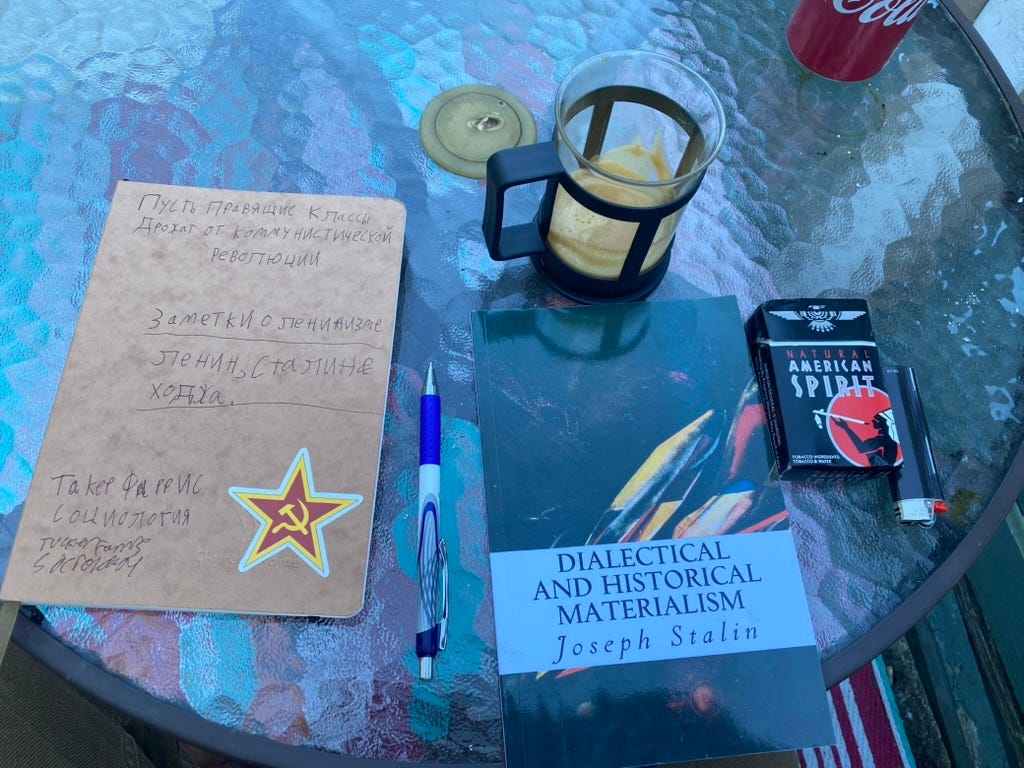
X. Digestif.
This is the end. What can I offer a reader to digest what has been said? What indeed has even been said? Is there a purpose to this essay besides serving as a much-needed distraction from real work that requires my attention? Is that not what a meal is after all? A departure from the responsibilities that plague us?
In the previous courses, what we have just shared together is something of a selfish, self-absorbed descent into things that ought not have existed, yet did so because I would much rather romanticize the mundane than face the actuality of being.
From here, go hungry into the next chapter, enjoy, reflect, savour.
Digestif
It is high time we drink water to supplant the madness.
You will require:
A glass of preferably old water
To prepare:
Ignore the reality that all we have been drinking contains water and concede to the hyrdists that you will at long last pour some of the neutral aqua vita into your abused stomach.
Enjoy.
A Parting Note:
“At the end of the day, it’s just food, isn’t it? Just food.”
-Marco Pierre White, White Heat
-30-