


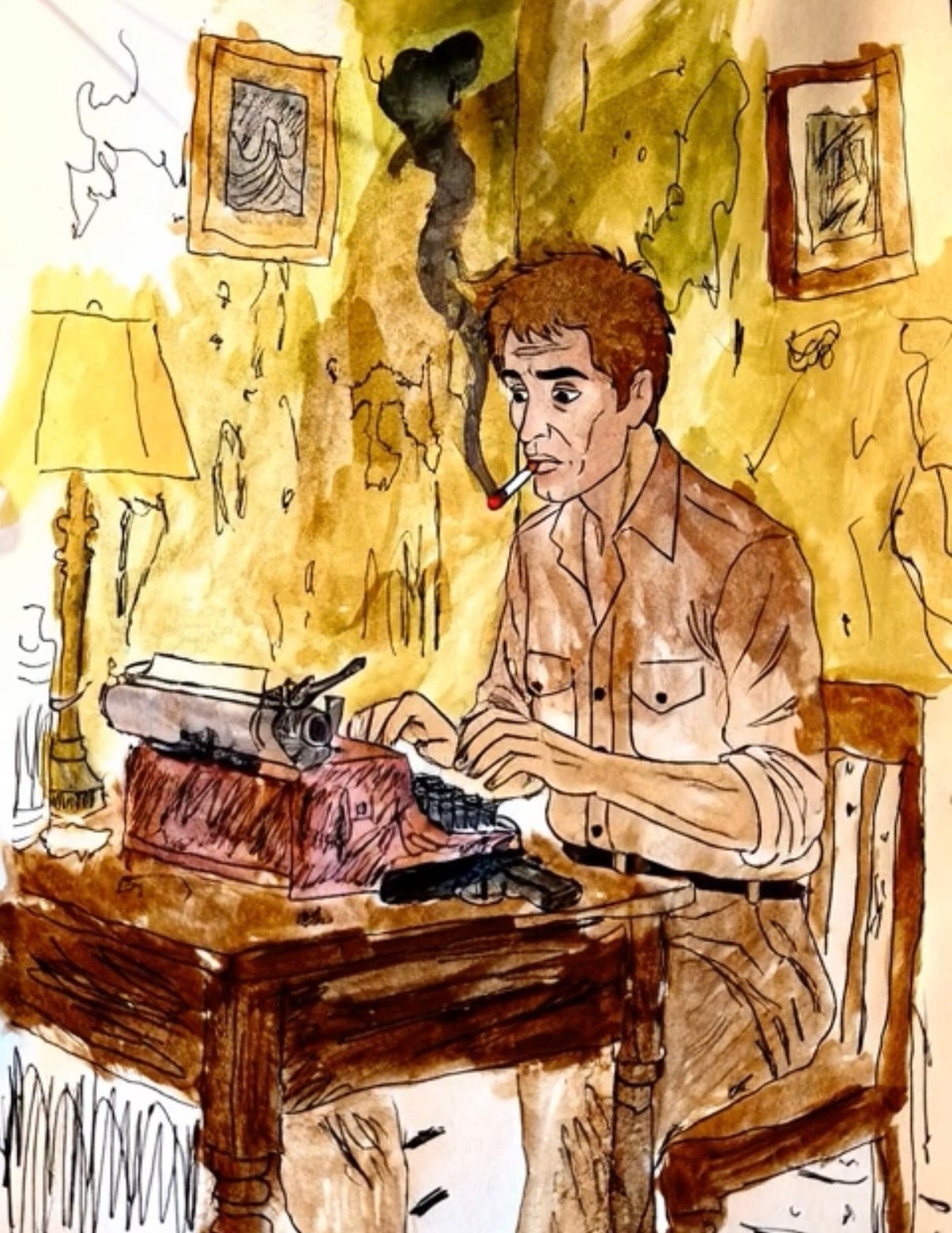
“What else has a journalist to do these days, after all, but report life’s miseries?”
-John LeCarré, The Honourable Schoolboy
“So much for objective journalism. Don’t bother to look for it here—not under any byline of mine; or anyone else I can think of. With the possible exception of things like box scores, race results, and stock market tabulations, there is no such thing as Objective Journalism. The phrase itself is a gross contradiction in terms.”
Hunter S. Thompson, Fear and Loathing at Rolling Stone
Riga, Latvia- I am on the cold concrete floor in a state of uneasy unconsciousness in the softened glow of the Samsung OLED television demo lounge in between concourses in Riga’s international airport. It is somewhere past 3 a.m., and I am surrounded by the trappings of the nomadic pseudo-philosopher journalist. Under my head is my leather rucksack that is full to the brim of 35mm, Polaroid 600, and Super8 film stock, a smattering of cranberry flavoured cereal bars hastily acquired from my favourite small grocery shop in Vilnius, various assorted gifts and trinkets picked up in my whirlwind 72-hour manic flight across Lithuania. Baltic pendants, some copper rings, amber beads, all the things that prove beyond a doubt I was in country for long enough to remember it. My leather shoulder bag is nestled beside me, and the strap is intertwined in my arm to make sure no one surreptitiously wanders off with it while I try to catch some sleep. Near my shoulder, a wasting paper coffee cup that held an overpriced latte from the vending machine half a kilometre down the concourse. It is perched near my trusty green four-season felt safari hat that has seen and absorbed rains from the southern deserts of Colorado all the way to the rocky outcroppings on the shores of the Baltic Sea and beyond.
I am wearing my traditional costume, the one of the traveler more comfortable on airport floors than most. An off-white long sleeve henley, down filled Patagonia vest, a thin scarf with intricately printed feather motifs, canvas jeans and well-worn and twice-re-soled suede Chelsea boots. To keep warm in the Baltic autumn nights on the concrete, I am wrapped in my weathered gold leather jacket and dangling from the buttonhole on the left breast pocket is my press card.
I awake suddenly from my restless sleep to the feeling of a sturdy military boot nudging my suede-covered foot. I bolt up to see a sharply dressed Latvian Border Service policeman standing over me at my feet. I am unsure how old he is, but it could not have been more than twenty. He has a half smirk on his face and, in an all too serious tone, issues a command I had only ever heard in movies:
Papers, Please.
In my barely awake state and perhaps reflective of the softening of the mind that comes from nonstop international travel punctuated by days of continual action, I replied almost forcefully:
Really?
He laughed (thankfully) and said, “No, but you do have a ticket, yes? Waiting for an early flight?” I said yes and made to fish my boarding pass from one of my inside pockets to which he said that I did not need to as he just wanted to make sure I had not slept through my intended departure time, which was not until 7 am that morning.
He disappeared back into the night.
I did not return to sleep, and instead gathered my scattered effects and made off for another latte and another four euros gone. Instead of returning to the OLED lounge, I situated myself in the small rectangular smoking lounge, opened my laptop and began to respond to the day’s students’ emails as they awoke to our first day of online classes together. This room was curious; it had motion sensor lights, and when you sat in it, it projected your silhouette outwards onto the opaque screens to create an Alfred Hitchcock effect. I had 11 Lithuanian Camel Yellows left in the opened pack, which was more than enough to serve as a hasty breakfast of nicotine and caffeine for the day ahead.
At 7, I would fly to London and take up residency in Gatwick for a few hours (enough to have a properly overpriced and undercooked full English breakfast), and from there it was north to Glasgow. From the labyrinth of Glasgow’s airport out into the carpark it was a sprint across the city to a caravan park on the banks of Loch Lomond, where for a week I would have the opportunity to decompress entirely from the madness of my traversing of Eastern Europe in the presence of a dear friend and creative partner.
Of all this, what comes back to me now, several years removed, is the curious decision I made to affix my press card to that buttonhole that evening. Press cards are an odd thing. In some cases, they are our shields against dragons, a beacon of access that allows us to enter into places the general public has not seen. In others, it is a target that is always situated right over the center mass.
Even the process by which I came by it was odd. Many traditional journalists covet their first press card and foreign assignment; it is an aspirational thing, a mark that you’ve ascended beyond the local crime beat desk into the fast-paced glamour of international intrigue. Mine was acquired in a manner that has led me to call myself an accidental journalist.
As I prepared to depart for Vilnius to live there for a month doing research on Soviet-era oppression and clandestine tradecraft, I had the wild idea one early morning to send an email to a childhood friend who was the editor in chief of our local paper. I had composed an article some months back detailing the human costs of the Russian invasion of Ukraine in 2022, and to carry on that identity, I asked if I could get a press card from him. Not so I could slip into the press corps rotating in and out of Kyiv (although I did), but for the more self-preservationist reason of needing a fallback cover story in the event that some misfortune befell me in the trenches beyond the iron curtain. My tradecraft was such that I would travel as a grad student doing research, but in the event Comrade Putin opted to move his military 30 km West into Lithuania, I wanted to ensure I had some form of life preserver to make it out as unscathed as possible. Raleigh issued me the press card, and over lunch before I departed, I said halfway-jokingly that if things went south over there, I would be counting on him to get me out, and he assured me in the same tone that he would. I didn’t doubt it, and what followed was an unplanned descent into the realm of journalism that I had never once considered a path I would take, let alone one that would lead anywhere.
Curiously, of all the jobs in the world, journalism, sociology and spy craft have such an overlap of methodologies that I am unsure today if they truly are separate fields. They rely on the same practices, the same identities, and the same truism that a desk is a dangerous place from which to view the world. They ask us to shed our safety, to walk into the unknown, and to adopt the empathetic observation of the mundanity of human life from a shell of quiet chronicling of the human experience. Good journalism, good sociology, and good spy craft all follow that same methodology: get to know your subjects, live with them, and report those intricate moments of human normality in ways that enlighten, inform, and inspire change. Each comes with its own share of dangerous moments, albeit in wildly different presentations, and each has its fair share of charlatans in the mists. In sociology, we have the uninspired, unenlightened researchers who dedicate their lives to the ivory ascension of academic positions, the ones whose research is buried beneath mounds of datasets and statistical analyses, the ones who may not even ever see their subjects, let alone come to know them. These sociological heretics are not terribly worrisome today, perhaps as one of the few benefits of the collective rejection of social science as legitimate science in the United States today. The charlatans that haunt the field of journalism, however, are far more terrifying.
Some reading this may immediately assume that I mean the political pundits, the talking heads screaming rage slop back and forth across four-way orgies of hateful incitement. I do not mean them. I do not consider them journalists. They are entertainers. I believe the real charlatans of journalism are far more insidious, far less obvious, and far more damaging to our collective survival in this modern era. They are not the ones spouting the day’s marching orders from their given political side over primetime television, and they are not the ones spouting lunacy in podcast studios. These people are operatives commodifying human attention; they do not deserve the moniker of journalist.
No, the real horrors are the real journalists who call themselves journalists and whose work never upholds the ethics of the craft, the mythos of the true power the pen carries, the ones who think that opinion pieces and fluff are the hallmarks of daily reporting, and who think that just because a story is controversial, that it is impactful. The power of the press is not in generating conflict or spectacle, but in making sense of both. Breaking a scandal is infectiously addictive, but if we do it just for the high of shedding light on juicy gossip, we’ve lost the plot entirely. If we trade in scandal, gossip and secrets without the drive or necessary constitution to speak out to the darkness of those secrets, what we are is nowhere near a journalist.
A journalist I respect deeply asked me a week ago who my journalism inspirations were. We joked at the moment that I would obviously need to say Hunter Thompson as I was wearing a lapel pin of the classic double-thumbed Gonzo fist on my jacket. Instead, my mind went to four different journalists that inspire me, and none of the four (to my knowledge) ever extolled the virtues of the Vincent Black Shadow motorcycle in Golden Gate Park, or would be portrayed by Johnny Depp in a film adaptation of his most feared and loathed work…
The names that came to me instead of dear Dr. Gonzo were: Mavis Gallant, Michael Herr, Sydney Schanberg, and Jerry Westerby. Three real, one fictional and all dead. We can toss in Harold Ross (founder of The New Yorker), a fellow Aspen local, as a consolatory afterthought, but where I draw inspiration from him is not in his reporting, but maybe in his management of a fringe society of rabidly talented writers. One may dream.
Mavis Gallant said once that she had hope to find a society in which she could live as a writer. Many of us who write are forced by the nature of our social constraints to be writers as hobbyists and toil away in other worlds to facilitate a living wage. She left the comfort of a Montreal columnist's desk and broke away into the immediate post-war renaissance of Paris. She said once that Paris was a place where you could tell a potential landlord that you were a writer and not immediately be shown the street. She melded into the world there, blending observational, reflexive journalism with sharp wit and carefully composed human short stories. Her Paris notebooks outlining her observations of The Events of 1968 stand among the best published words known to humanity. A careful, clever and human recollection of the closest any modern Western state has come to a pure revolution to rival 1789. She followed the student uprisings, the strikes, De Gaulle’s movements through the crisis, and the panic buying of everything from petrol to cigarettes. She told the human side of journalism in exacting precision, from the mundanity of a stroll in the Bois de Boulogne to the encroaching intensity of a city slowly marching towards an explosive revolution. She characterizes her neighbours, her friends and the odd passersby that she joins in her strolls through the warzone of 1968 Paris in ways that feel familiar, and entirely ethereal. Ultimately, it is not the story itself, not the conflict or the political fallout or the student movements that capture the reader; it is the humanity of the people she sees and speaks with. It is a reminder that even in chaos, in cathartic human moments of carnage and conflict, we are there in the streets as people first, observers second, and humans above it all.
Dispatches by Michael Herr is the only book I have ever read that has truly haunted me. Herr was the quintessential war correspondent of the modern age. Writing for Esquire in ’67, he covered Vietnam and became the archetype that some of us aspire to approach in our own wild dreams of correspondence work. Vietnam was the television war, after all. The first modern conflict broadcast live and in livid color to millions of screens across the world, and for many on the homefront, their first experiences of the horrors that followed you in the trenches. War journalism is not a new or modern medium; it has been with us as long as we have been keeping our journals of the goings on of the world. A war correspondent even graces us as a companion of T. E. Lawrence in the Panavision masterpiece, cementing our place in cinematic history (his name was Lowell Thomas and would serve as another tangential inspiration). Although I think what constructs the war correspondent in our minds more prevalently than Thomas in Lawrence is Dennis Hopper’s foreign correspondent in the final moments of Coppola’s Apocalypse Now. Dressed in a strange mix of US special forces tiger stripe camouflage and a battered Montagnard shirt, Hopper’s photojournalist is laden with bronzed Nikons and the ever-iconic mid-60s aviators. In the film, he is the manifestation of the existential investigations of the original Heart of Darkness story, being the one that in a coked-out outburst, utters that famous quip adaptation of Kipling: “Did you know that “if” is the middle word in life?”
But Herr’s articles in Esquire and his masterpiece Dispatches do not contend with the fantastical, or the heroic ideal of the war correspondent as idealistic or aspirational (unless he discusses the undisputed charisma, courage and talent of the likes of Sean Flynn, who disappeared somewhere in Cambodia when the Khmer Rouge took power). Instead, Herr chronicles the dehumanizing madness of the conflict, the endless rivers of blood and insanity that surrounded him. He details the flights in helicopters, the arguments with commanding officers and the knowledge that at any moment a bullet may come down the hill into your throat and you’ll have died thousands of miles from home for the ink in a weekend edition.
Dispatches did not inspire me to become a journalist so much as it inspired me to revere what the cost of good journalism is. In the end, it is not the day rates or the cents per word, or even the page placement of the story, but it boils down to a craven human need to preserve our experience. To share the reality of the world, and to be a voice of truth, not as a crusader, nor a prophet, but as a journalist who watched Hue city burn and rot and chose not to stay silent, but to commit the experience to the written word. I did not feel the burning desire to fly across the world and dodge bullets for my paper after reading Dispatches; instead, I wanted to become the type of journalist who could someday be as careful in such an endeavour as Herr and all of his compatriots from the various wire services were. There was a moment in 2023 where, with life as I knew it in Canada fading into memory and no real anchors to anywhere else, I nearly decided to spring into Kyiv and start trekking across in armored personal carriers alongside Ukrainian soldiers and trying to sling my words and photos at any paper back home who would have me. What stopped me was the realization that I was contending with that decision to quell a sense of restlessness in my own heart, and not for the right reasons. It wasn’t about wanting to cover the story, I think somewhere it was a desire to taste that feeling of total self-destruction that had haunted me in the Great White North for a few delirious years. Curiously, I would come to dodge bullets while writing dispatches about the war in Ukraine for my paper back home, but rather than hiding in a trench from Russian shells, it was a less than graceful dive into oak leaves as I escaped a posh weekend French countryside fox hunt on the fringes of the Ardennes…
In keeping with the time and place of Herr’s writings, last year I was introduced to Sydney Schanberg’s book The Death and Life of Dith Pran, chronicling the chaos of the Khmer Rouge overthrow of the Cambodian government in April, 1975, and the frantic and harrowing escape from Phnom Penh by Schanberg and other American, British and French journalists (including photojournalist Al Rockoff whose photos of the fall of Phnom Penh are among the best pieces of photographic human documentation known to the craft). The book also chronicles Schanberg’s obsessive dedication to finding his best friend, assistant, photographer and fellow journalist Dith Pran, a Cambodian who covered the illegal US incursions into Cambodia with Schanberg for the majority of his time in country. Pran was deported from Phnom Penh with millions of other Cambodians by the Khmer Rouge and interred in the killing fields to toil in forced manual labour and routine indoctrination by the KR. Eventually, he escaped and trekked through the jungle to Thailand and Schanberg and Pran were reunited and did not stop covering the emergent genocide in Cambodia.
The book is not the journalism we expect to see in our dailies or in even more longform content. It is above the norms of the modern print rag and a class of narrative clarity that I do not think we can reproduce again. The tension of the fighting in Cambodia, the eerie quiet of the city on its fall, the frantic unease of listening to soldiers discuss their desire to execute you in Khmer while you, an American, know little to nothing of the language, the uncertainty of holing up in the French embassy as a major moment in geopolitics unfolds in gunshots and executions around you. All of this is in Schanberg’s book, but not as the story, as the background. As a reminder that journalism comes in as a notation to the chaotic background radiation of the human condition, that being there to document and record is the secondary afterthought of the human in that inhumane moment. Pran’s heroism is central to the pages as well, the man who quietly and politely negotiates Schanberg and Rockoff’s survival when the Rouge were ready to add theirs to the already tall piles of corpses in the capital city, the man who ensures his wife and children are on one of the last American helicopters out of the falling city, the man who in that moment knowing it was almost a guaranteed death warrant to stay in his native land, decided to stay with the foolhardy American reporters to document the aftermath of American meddling in Cambodian society. It is a story of the survivalist heart at the core of the human experience, and the uniquely calm allure of the journalist in dangerous places, to stay until the story is told, and to tell it with the reflexive humanity needed for the words to impart a meaning to inspire a difference half a world away.
I am not inspired by these stories to become some heroic journalist, and I do not hold some lofty ideals of what my own writings may do or cover, but rather, I am humbled by each of them. By Gallant’s fearlessness of being a real writer, casting aside her home comforts and trudging out into the world or into revolutions for a baguette, an espresso and a cigarette outside the Sorbonne as cars burn with purpose around her. Humbled by Herr’s accounts of coming face to face with the utmost absurdity of human horrors and coming out, not untouched, not un haunted, but determined to take refuge in the page as all us writers do when the storms of our mind require a mulling in print. Humbled by Schanberg, Pran and Rockoff, staying behind in the city of death to make sure that the stories of tragedy there live on in the collective conscience of the world to this day. Humbled not by political pundits, talking heads or fluff reporters, and not by writers masquerading their personal journeys as critical journalism, or even by Hunter’s forays into the strange and savage madness of the American century, but by the real essences of real writers, the ones who strove out into the world not with a mission, but with a camera, a notebook, a press card and a deadline. That is what inspires my journalism in part, the true humanity of it as not only a genre of writing, but a living and breathing odyssey of our real nature. A capturing of the moments of life that transcend mundanity into the realms of the bizarre, the hopeful, and the emotional. The careful application of an observant eye to the intricacies of our shared lives on this planet, with the goal not of making a new world for ourselves, but in keeping a record between the pages of our papers of the world passing us by moment by moment. It is that solemn dedication to the story, to the bright moments, the historical milestones and the utter human horrors, the dedication to being a custodian of the world we inhabit, and carrying the trust to share it with others. That is what enlivens the reverence I carry for my press card, my camera bag and my field book. Not the unrealistic assumptions and aspirations that my work will carry the weight of giants, but that, in some way, somehow, my words can impart a sense of human wonder in the worlds I wander.
The inspiring journalist I have yet to discuss here is the most impactful in my own entrance into the craft, I think and curiously of those names listed, the only one who lives between the pages of a fictional novel.
My regular readers may tire of my evocations of one Jerry Westerby or my tiresome overuse of LeCarré quotes in my work. I can imagine that for some, the over-reliance on 1970s British spy fiction is something of a laughing matter in my outlaw philosophies. For instance, it was only upon the final inspection of my doctoral dissertation that I realized I hinged so many of my far-fetched notions on the operational gravitas of a LeCarré quote at the top of the section. I digress that this may be a literary foil in my work, a rhetorical device to evoke an English teacher’s lesson. There are worse things to use. For a long time, my theory work relied grossly on overused water metaphors, shaking ships, calm ports in storms and the like. My ongoing project, “Two Prayers for the Lost Souls in the Endless Night,” hammers home the metaphor of a dark and mysterious woodland more explicitly than I would like, and I am certain that some readers (and definitely other theorists) grow tired of my obsessive dedication to a symbolic interactionist constructivist outlook on the sociological world. But conventions be damned, and God forbid a writer have a pattern and be thankful I’ve always rebelled against the ludicrous notion of essays needing ‘hooks’.
With this aside, Jerry Westerby, the titular character of LeCarré’s novel The Honourable Schoolboy, represents a pinnacle of inspiration in my accidental forays into journalism. The novel, sequenced as the second in what is known as The Karla Trilogy, follows the events of LeCarré’s more popular novel Tinker, Tailor, Soldier, Spy and serves as a bizarre interlude in the fictional world of the mid-70s British intelligence service. Tinker is a well-loved classic of the genre, weaving excellent prose with the intrigue of a grimy investigation into Cold War tradecraft by his most successful literary creation, George Smiley. The novel follows retired spymaster Smiley as he slowly and meticulously unravels a “mole” or double agent in the SIS and follows his methodology to uncover the truth of the matter. It is not the face-paced globetrotting action of Fleming or Clancy, it is something wholly unique, morally grey, painfully mundane, and Smiley, the novel’s hero is not suave and debonaire like James Bond, nor is he as prone to action as Jack Ryan, instead he is old, fat, irritable and boring, trapped in a failing marriage and pushed out to pasture in an early retirement at the bequest of the mole he is hunting. The novel is bureaucratic, meticulous and demonstrates the intricacies of spy craft, not as a glamorous affair, but as a dull intellectual gauntlet of sleepless nights in dingy hotels, where trust is the most valuable commodity after the truth and where heroism is not rewarded with love or money or notoriety. It is a testament to the quiet background work of such individuals, and it is one of LeCarré’s most-loved novels.
The Honourable Schoolboy follows none of these conventions. Beginning in the aftermath of Tinker, the book follows the desperate recovery of the SIS in the wake of the exposure of the mole in their ranks, and it centers not on George Smiley nor on London Station. Instead, this novel, which has informed my accidental journalism career, opens on a typhoon Saturday in the waning days of the British colonial rule of Hong Kong. Not with seasoned espionage agents, not with a plot at intrigue or clandestine operations, and not with any discernable thrills. Instead, the story begins in the Foreign Correspondent’s club, shuttered inside on a typhoon Saturday, wherein the motley gang of foreign correspondents from former British colonial outstations gather for their regular indulgences of alcohol to excess. The momentum of the novel begins when they trek through the rain in a Mercedes taxi to High Haven, the regional headquarters of the SIS in Hong Kong, to which they travel to hunt down the rumour that the British intelligence presence in Hong Kong has suddenly and without notice vacated their headquarters without a trace.
As the story unfolds, it is not through the eyes of spies, per se, but filtered through a tangential retelling of the author’s own time spent in East Asia as pillar after pillar of Western colonialism fell into the dust of history.
Jerry Westerby enters the story as a washed-up former field agent, tossed out from the service as a result of the aforementioned double agent. He is a journalist by trade, and a respected one, but he begins his story in a quiet retirement in the hills of Tuscany, far removed from any and all espionage or intrigue. He is eccentric, both to the villagers he lives with and later to the countrymen he returns to in England. He balances his battered typewriter on mass market paperbacks and is never seen without a worn-out jute shoulder bag and broken-in buckskin boots.
Westerby is recalled to service and resumes his cover as a freelance stringer on the East Asia beat, travelling across the novel to Hong Kong, Phnom Penh, Vientiane, and the remote jungles of Vietnam in the immediate aftermath of the US defeat in the Vietnam War. Westerby is a quintessential foreign correspondent, one entirely capable of maintaining his entire operation out of his suitcase, so long as there is a live wire to the Associated Press and paper for the typewriter. We follow our intrepid ‘field man’ on a series of misadventures across the war-torn part of the continent, wherein slowly the reality of the Western hand in the destruction of the region becomes more and more difficult to ignore, let alone justify. We, the reader are vaguely aware of The Mission, but what emerges is not the tale of spy craft, but rather the tale of a journalist leaning on his cover producing accidental intelligence. Observing the leads as they present, following the rumours and calling upon the connections made in the practice of our craft, knowing who to meet for film, for an in on a publication, and as a mark of the time, who to bribe in the airport to read flight manifests, and how to negotiate access to a closed airfield.
The journalism inspiration in this novel does not come from the articles Westerby writes, nor from the beats of the story full of suspense or action, but from the normality of the way the character traverses the chaos. Hong Kong, on the eve of the Chinese takeover, is not a city on the precipice of monumental change to Westerby; it is a place steeped in a diverse expanse of cultural history, and one where the mixture of wealth and status with the destitution of extreme poverty plays out in the neon-lit streets in the Kowloon fog. Phnom Penh is not the capital of Cambodia, poised to become a killing zone at the hands of the advancing Khmer Rouge, but rather it is a city of French colonial splendour whose Parisian opulence and peace are only mildly interrupted by artillery shells falling in the streets. All of them are romanticized reflections of the potential stories, experiences and moments to be had in a sprawling expanse of the great unending streets of any major city. Westerby relays their realities to us the reader not as factual reporting on military operations or political upheavals, but in meals shared, romances coveted, and vaguely in the din of the adventurism, the reality that there is more to be discovered than the simple cover story of foreign correspondence.
I think the call of this text to me and the reasoning for its lasting impression is not the dingy glamour of these cities, nor the wanton adventuring of Mr. Jerry Westerby, but it is in the enveloping of the narrative of something as simple as a spy story into a characterization of the true heart of the journalist’s spirit. The idea that it is a calling to step out into the ordinary world, to recognize the chaotic forces swirling around you, and still find the time to be a human being experiencing life with other human beings. In moments of uncertainty and madness at the state of the world, it is the job of a good journalist to be the calm level head in the bluster, to see through the fog into the reality of the everyday and to report not what is shocking, but what is needed to be read.
The spy craft follows, and it is inconsequential. The heart of the story is the wayward heart of Westerby in his treks across battlefields, nightclubs and slum apartments, from the dockside to the penthouses, where the journalistic spirt is one of learning to learn about the world from being in it, about listening to the rhythm of the nature of things around us and knowing when to speak, when to write, and when to walk away. I do not identify with Jerry so much on a personal level, but I have felt echoes of his journeys in my own foreign meanderings. Not having been a member of such a club as the Foreign Correspondents of Hong Kong, but still having traded many a conversation with journalists from all over the world in some less-than-pleasant locales. I have known the feeling of wandering a foreign-to-me city late at night, the experience of gauging the collective tension of a place in a period of national anxiety, and I have learned to develop the particular gaze you come to cherish in such situations, the one that lets you gauge an interaction twenty meters across the courtyard of a church, the one that gravitates you to the poorer quarters where the ragged people go, and the inner voice that grows in the back of your mind to tell you when to turn sharply away from a thread you’re following. I have never been in Jerry’s buckskin boots, but I have done my fair share of walking in my own suede Chelseas to know that there is something incommunicable about the beat, about being back out on rotation, about hitting the pavement for a story, or the unconscionable pleasure of having one come to you over espresso in the wee hours of the day. I have come to treasure the moments in an apartment or hotel room somewhere on the other side of the world where I find peace and comfort in the noise of the keyboard and the collation of words on the page. For me, in these instances, it is not about the chance at them being published or the thought of what may come in return for such things, but it is the chase of it all. The intoxicating feeling of finding a thread and pulling it along until you unravel the truth. This is what I love more than anything in this line of work, and what calls to me from LeCarré’s representation of Jerry’s wayward journeys through the backstreets of Hong Kong and the battlefields of Laos and Cambodia. Not adventurism, not the commodification of travel as a means of writing a story, but the stories that come naturally when we step into a new city with the mission of looking for them. I do not travel for the pleasure of it, and I do not compose my works on location as travel blogs or some attempt at grading out some compensation for them. The dispatches I submit over the wire are ones I am passionate about sharing, and the ones kept elsewhere are the voices that come through me in my travels. I strive in these journeys to do as Jerry did, to an extent, to exist in these places as something between a tourist and a local, something of an interpreter of stories deemed too mundane for the big players to cover, or too faraway to be considered important. My experiences in my solo journalistic wanderings have not been the ones that present nicely on paper as a travel journal, and since I have yet to take a real ‘vacation’ in years, it feels as though my solitary wanderings are endless streams of work at this curious call of ours to uncover something about our new temporary home.
Journalism to me is not a way to rationalize a trip to see the world, but rather a calling to bring the world home in print. It is a critical privilege of ours to be the voices that can remind us that no matter how isolated or disconnected we feel from the events beyond our borders, we always have some degree of reliance out there on the real world over the mountain pass or beyond the river bend.
It began, like all things, on a Typhoon Saturday…
My new journey in this craft is now laid out ahead of me, and I am poised to begin my own walk up the hill to the High Haven that will illuminate the next adventure for me. It began, much like Jerry’s wanderings, on a Saturday. Removed from the worries of Typhoons high in the Rocky Mountains, the tone instead was the creeping cold that accompanies the onset of winter, and the enhanced chill of that cold as it is amplified inside a century-old home without a fire lit. Around a table in this home, the conversation carried would eventually lead me to sign a contract to purchase a newspaper, and to step into the role as editor-in-chief of my own newsroom at the age of 31. I have called myself an accidental journalist before, primarily because my baptism into the craft did not come in formal journalism degrees or the working of my way up the rungs of publications from cub reporter to the vice desk.
It started with a series of serendipitous movements through life that now flash into my memory in very quick, successive vignettes. A photo shoot for Mother’s Day in the late 1990s for The Valley Journal, where, in black and white newsprint, I made my inked debut cradled as an infant in my mother’s arms. Three years later, a colour photo of me on the front page of the Journal dressed in a tricorn and red coat, waving an American flag for the Fourth of July parade. A decade later, a chance encounter at The Castle introduced me to the paper I now own, and the first opportunity to contribute a photo for publication. A decade later, and I submit my first opinion piece to the successor of the Journal, a sweeping condemnation of that paper’s decision to feature a prominent photo and puff piece about the local police on the cover of the issue, a week after featuring Black Lives Matter protests and highlighting the malignancy of police brutality. Curiously, after that piece, I received my favourite critique on my writing that I have ever received. A week after my column appeared, a well-known local racist, homophobe, police violence enthusiast and generally unlikable character submitted a letter to the editor of the paper that ran. It was not a long letter, but this racist neighbour decided that the best insult he could lob at me in his rampant disagreement with my piece was that my headshot was “Hemingway-esque.” I have laughed internally about this since then, and also take a sense of joy in the fact that all the local racist could think of to condemn me was to compare me to one of the quintessential writers of the last century.
Following this escapade, I landed in the previously discussed luncheon to receive my press card and off into the wild blue of journalism did I fall. That was three years ago now. As I write this essay, the fog rolls off the river into the valley that I now am trusted to cover. From my perch on the side of the valley, I cannot see through the fogbank far enough to even discern civilization. I am alone at my desk, surrounded by the trappings of a good night of writing. Two empty coffee cups, a half-empty bottle of soda, notes, pens, headphones, lighters, Lucky Strikes and two very tired dogs who want nothing more than to go find their beds and sleep on into the dawn.
It has been a long time since I have sat at the keyboard as the sun rises, and given that it is now 7 am and I have done so, I feel a certain sense of revival in my spirits about the nature of writing and the tasks unfolding before me as I transition from man in the field to the other end of the wire. The weeks since inheriting this posting have been a blur. Partially a press tour, partially a mad scramble to pick up the reins and find a logical direction forward to make sure the press gets paid, that I know who even is advertising in my paper, and when and if they need to be invoiced, I know who if any writers existed or remain to exist under my watch, and a sense of purpose in a clearly concise vision for the future.
In all the chaos, there is a background hum directly contrary to the din of wartime horrors. There is a background chorus of support, of excitement, of wonder at the possibilities. In almost every conversation I have had since the news of my new role hit the stands, I have heard an overwhelming sense of pure excitement from the readers I have spoken to. So many are excited to see how I improve the paper, have shared their direct critiques of the paper as it exists, and their suggestions for where it ought to go. Several have remarked that they will begin reading it for the first time, and some have also remarked that they will start reading it again.
It is a unique situation wherein a local buys a local paper. These things rarely take place anymore. Our flagship media sources in the region seem to be folding left and right to corporate buyouts, with the news and journalism being reduced to a business deal and contracts and bureaucracies rather than the core heart of the craft. I have yet to fully grasp the gravity of the unique position I have seemingly fallen into here. A chance for the local kid to uphold the local paper. No corporate buyouts, no out-of-state acquisitions, no vanity projects. Just a celebration of the roots at the core of community journalism. The chance to cover the happenings both near and far, to explore the vibrancy of the cultural moments we all share, and to be a steady and consistent voice on the various elements of life in my own hometown. The excitement I feel is not at the prospect of local celebrity, or the collection and commodification of secrets and gossip, or the immense power over information. Instead, the excitement I feel is the chance to be there along with the people who have always been beside me as I grew up, for the good, the bad, and all the times in between. I do not see this as a business investment or opportunity, but a near-sacred charge of infinite proportions. The responsibility to be the custodian of the collective cultural spirit of this place is the most solemnly important undertaking I have ever shouldered. What lightens that burden is the warmth, the care, the compassion and anticipation from all of those around me who followed my journey away from this valley and back to it, who followed the strange journey that I am now officially starting at the paper. At every triumphant victory, every heartbreaking defeat, and every confusing twist of insanity, this community has directly and indirectly been there beside me and when I was finally able to share with these people that after a handful of odd months of deals and emails, that I had successfully landed the paper, the smiles, the hugs, the congratulations have reflected some of the most cherished moments I have had to date in this community.
As I look toward the road ahead, I do so not as a product of anything I have done, degrees I have earned or classes I have taken. I am a product of the community around me. The mentors who have taught me to use my voice in the walls and wires of our hippy radio station, the mentors who saw that I had words to share, but difficulty writing them down and who stayed with me in patience long enough for me to learn to type, the mentors who came with words of comfort and care in darkened moments across all hours of the night, and the mentors who still today will never hesitate to offer advice and wisdom when the way forward seems murky. I undertake this task as an accidental journalist with confidence, knowing the people in this place I love are counting on me to cherish and protect their stories, and with the knowledge that they are caring and kind to the point where they will be there for me to ask for help when and if I need it.
Ultimately, I step into this role ready to embody the community that has taught me over a lifetime that when we work together, share, support one another and grow together, the stories we share are that much more meaningful, and all the more important to chronicle for next week, next month and next century.
-30-
TF
The Accidental Journalist